The Trouble With Math
My dad was good at math, and I seem to have inherited that “gene” as have my children. I’ve always enjoyed working with numbers, though my fifth grade math teacher might not believe it, she tried to teach me long division. It finally clicked in, but only after some stress on my fifth grade brain.
Members of my senior class had taken algebra I, algebra II, and geometry during their first three years in high school. We were wanting more math for our senior year and petitioned the principal for a trigonometry class. We met an hour before the regular school day called it “Zero Period”.
My daughter was offered calculus in high school, and it was helpful to have it on her high school transcripts when applying for college.
My mother used to ask why we were being taught algebra in elementary school. She was not a numbers person and math homework that posed a problem like “3 + __ = 7” was what she saw as algebra. She just didn’t understand “new math.” The math wasn’t new, teaching it was different than the memory route she’d learned in elementary, and promptly forgot,. She had to relearn what she needed for keeping track of her bank account.
Many of my jobs throughout life have been bookkeeping. I liked making things balance, and when things didn’t balance, I checked and rechecked my entries to see where I had erred. Usually it was in transposing numbers somewhere, and knowing if it was a simple transposition, the entries would be off by 9 cents, dollars, tens of dollars, hundreds of dollars ….
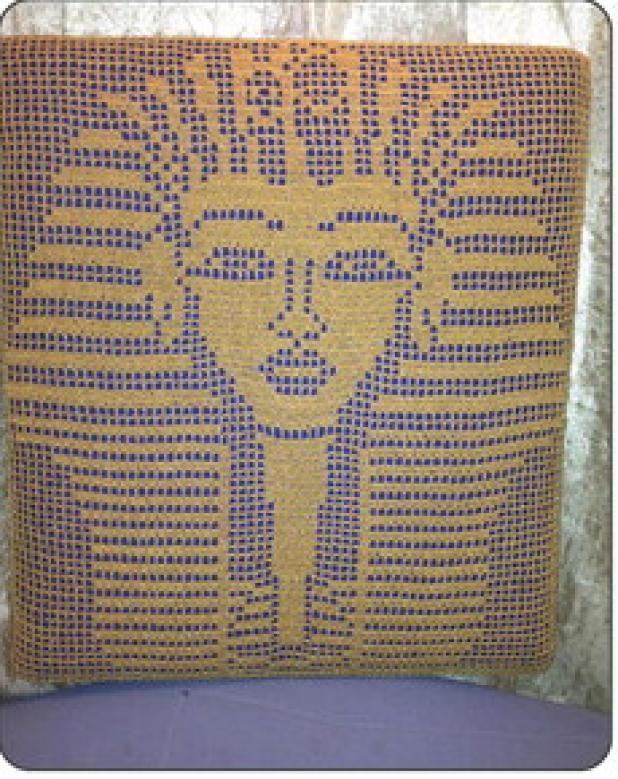
My retirement still involves working with numbers: crochet, counted cross stitch and needlepoint rely heavily on counting stitches or rows. I took a pattern made for a stuffed toy’s hat and made it into a hat that’s big enough for my grandchildren’s Halloween costume. It takes an understanding of numbers and how crochet work to figure out how to make a hat from a pattern that has a 13-inch hat band to a hat with a 20-inch hat band. With numbers I can create my own crochet patterns for simple afghans or throws, or filet doilies and more. I took a screenshot of the mask of King Tut, put a grid over it and created a wall hanging of the burial mask.
But some people are uncomfortable with numbers and working with them. Teachers tasked with teaching math sometimes find it difficult to get across to students who struggle with math that math will be important in the future. Students wonder what numbers and manipulating them are going to help them once they’re adults.
A welder, for instance, uses math in measuring materials and determining angles to make what they’re building fit nice and tight, and make a sturdy structure that won’t be out of balance and fall over or fall apart.
Bookkeeping and accounting, of course rely on numbers, that’s the tool they use for their job right along with their calculator.
Imagine a carpenter without a hammer, he couldn’t complete the project, and if he can’t read a tape measure, he’s really in trouble.
Mechanics have tools in US standard and metric measurements, but if you don’t understand inches and fractions of inches or centimeters and millimeters, work is too slow and the job doesn’t get done in a timely fashion which could affect their income. The more autos or equipment they can repair in less time means they can work on more jobs and make more money.
Chefs, cooks and bakers, deal with measurements. From 1/4 teaspoon to multiple cups, they need to be able to increase or decrease the measurement of ingredients to make enough, or not make too much depending on the meals they’re preparing.
Doctors, nurses, and scientists all need an understanding of numbers for their careers. Blood pressure measurements, heart rates, prescriptions, weights or measurements of chemicals all involve numbers.
Computer programmers use numbers beyond my imagination to create operating systems, applications and games.
An understanding of numbers can help you make decisions about large purchases like a motorcycle, an automobile, or a home. Understanding how mortgages and financing works may help you to decide, “I can afford this” or “now is not the right time for that expense”.
Keeping track of hours on a timesheet, making change in a fast food restaurant or store, keeping mileage figures on a company vehicle. Eventually every adult finds a need to understand numbers, maybe not all applications of numbers, but what they need to balance a checkbook, or make sure they don’t overdraw from their debit account and end up with a negative balance and the fees that brings!
A person doesn’t have to know everything about numbers to succeed in life, but it’s important enough to know all that you can learn in public school either to help you with a job or getting into college.
So I’m thankful for that math gene.“Old” math, “new”math, math is math, add, subtract, multiply, divide, fractions, decimals, and even negative numbers, math is important somewhere in everyone’s life.