
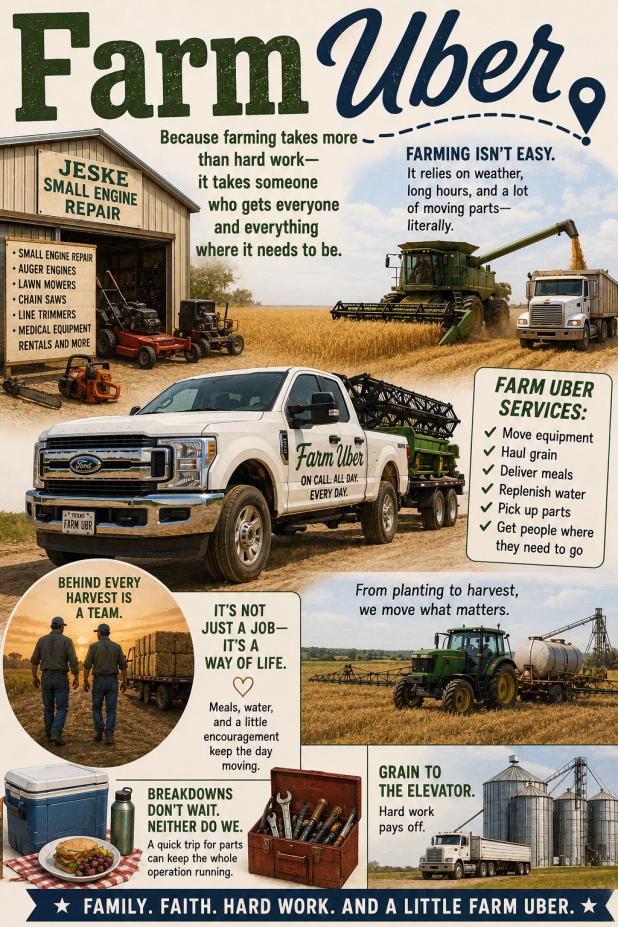
Harvest Runs On Farm Uber
My father-in-law was a farmer, as were many of his siblings. But farming relies heavily on the weather and many other things. When his children were small, Mr. Jeske opened a small engine repair shop in town. Farmer’s auger engines were part of his work. He added several things to the business, such as renting medical equipment. Eventually, he sold lawn mowers, line trimmers, and chain saws, as well as working on those and other small engines.
His sons ended up working for farmers as soon as they were big enough to load square hay bales onto a trailer or into a pickup. As they grew, they began working after school and during the summers for a local farmer. Each of them went to school, one for welding, the other for diesel mechanics. Their education completed, they moved home and went to work full-time for the same farmer. As we prepared for our wedding, I drove a pickup while my future husband loaded the hay bales.
Before my husband and I married, he’d stopped working as a farm laborer and began working as a diesel mechanic, working on farm tractors and equipment.
When their uncle passed in 1981, their mother inherited part of the estate, and the boys began farming that land. The hope was that it would mean a little extra money, after all the equipment was paid off. But like I said, farming is not easy. They worked day jobs and farmed in the evenings and weekends.
Our son got the farming bug. He went to college and got a degree in Ag Business with a minor in economics. He now farms the family farm and leases other farmland, raising wheat. And he has a nine-to-five job to support his family.
But there’s one thing about farming that many people don’t necessarily hear much about. Moving equipment from one field to another is no small job. We spouses have dubbed it “farm uber!”
For instance, the combine: its header has to be loaded on a trailer and driven to the field. Trucks haul the wheat to the grain elevator so it can be sold. A truck has to be in the same location until the field is completed. Most fields produce enough grain that a single vehicle cannot contain the field’s entire production. We have two different grain trucks for this task. Someone has to haul the grain to the elevator so that the combine can continue cutting and fill the second truck.
The second day of harvest, my husband and son drove the combine and a pickup that hauled the trailer with the combine header. I was called to move people, and drove them back to the original field so the two grain trucks could be moved.
While our son started cutting the wheat in his field, I drove my husband to where his personal pickup had been left. His truck is supplied with mechanics’ tools, if needed, for emergency repairs.
I keep track of mileage so it can be deducted come tax time. That day was only 25 miles, and the harvest is nowhere near finished. Mileage varies; in three days, I moved equipment operators about 75 miles.
Our son farms acres on Highway 114, west of Olney, and another pair of fields south and west of Highway 79. He owns a couple of fields east of Highway 251 South and leases another set of fields farther east. And this year, he did come custom cutting for another local farmer, whose field isn’t far from our equipment yard.
Sometimes part of our “farm uber” job is to take meals to the fields; otherwise, farmers wouldn’t eat until very late. They make sure they have plenty of cold water while they’re working in the heat. Or they can call on wives to replenish the cold water. And occasionally there’s a trip out of town to pick up parts to keep the equipment running.
But harvest isn’t the only time Farm Uber is needed. When fertilizer or herbicide is to be applied, a tractor with the spraying equipment and a trailer with a tank for the chemicals both have to be at the site. And with as many fields as our son works, that requires lots of moving.