
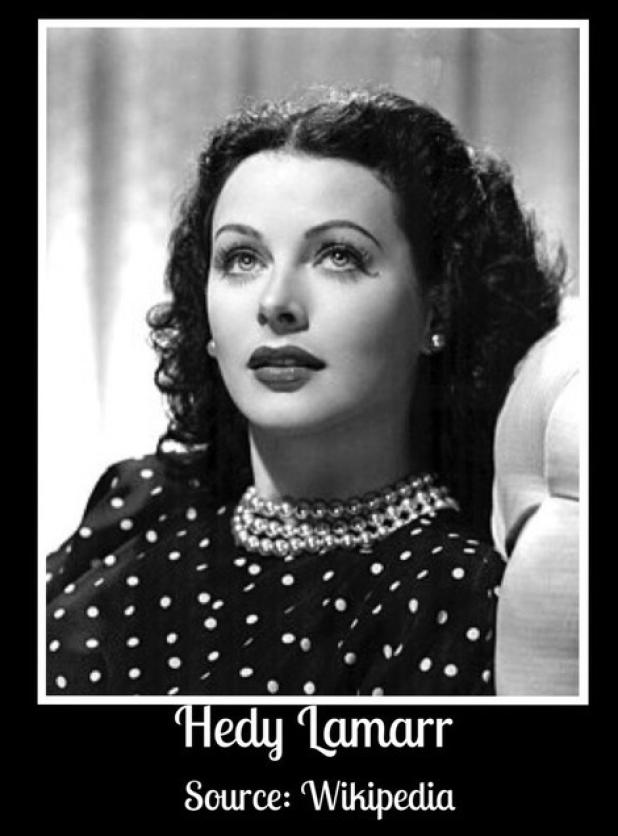
Women’s History Month: Who Was Hedy Lamarr?
Recently, I read a fascinating story about the actress, Hedy Lamarr. Most people will not even remember the name. I vaguely remember her as an actress in the 1940s and 50s. Her old movies can still be seen on TCM Network.
Hedy Lamarr, the Hollywood actress, who was also a brilliant inventor. She co-designed a “frequency-hopping” system in 1941 to protect Allied torpedoes from jamming—a groundbreaking idea that later became the foundation for modern WiFi, GPS, and Bluetooth technology! Who would ever imagine that?
Hedy was born Hedwig Eva Maria Kiesler on Nov. 9, 1914 in Vienna. She grew up the only child of a Jewish father, Emil Kiesler and Hungarian mother. Math came naturally to her, and engineering concepts made sense to her long before she ever entered acting. She watched, listened, calculated, and she learned quickly.
She married Friedrich Mandi, one of Austria’s richest arms manufacturers. He was controlling, paranoid, and was deeply connected to the rising Nazi regime. During gatherings and dinners she sat quietly, pretending to be bored by the talk of radio-controlled weapons. She wasn’t bored—she was absorbing every word.
Mandi was so controlling that he tried to imprison her in his castle. But, in 1937 she escaped to London. There she met Louis B. Mayer, the Hollywood movie producer. She sailed to America, and changed her name. She became the very successful, award winning film star, Hedy Lamarr.
She dazzled the world, but behind the glamour, she was haunted by the rise of the regime she had fled. She wanted to create a radio communication system that couldn’t be jammed— a way to guide Allied torpedoes reliably to their targets.
She already knew the problem: a single radio signal was too easy for the enemy to intercept or block. Her solution? Spread the signal across many frequencies. Hop between them so quickly that no one could jam it.
How to solve the problem? She turned to George Antheil, a composer who once synchronized twelve player pianos in perfect unison.
Together, she and Antheil built a frequency- hopping blueprint using piano-roll mechanisms. They were awarded the patent for their invention on August 11, 1942. That invention became a significant component that helped the Allied Forces to win the war.
The world had no idea that one of Hollywood’s most glamorous women had just invented the foundation of modern, wireless communications. They were too busy staring at her face to notice her genius!