


Try Texrail For a Cheaper, Calmer Way to Reach DFW
with
Airport parking can be a significant expense for holiday travel. I explored a new strategy on my way to a funeral.
I took the Texrail to DFW Airport. Their stations in Fort Worth, North Richland Hills, or Grapevine are essentially equidistant from Olney. Consult the online timetable. I chose Smithfield Station in North Richland Hills because it combined a short train trip with the availability of long-term parking. Most Texrail stations allow free parking for commuters, but if you intend to leave your vehicle for a longer period, you need to download the Ace Parking App and reserve a space ahead of time at one of five specific stations.
I dislike it when a business requires me to download their app, but the prospect of $5/day parking outweighed my reluctance. It had a 2.3-star rating on Google Play, so it has room for improvement, but it helped that I already knew where my station was on a map. I successfully uploaded my vehicle and payment information. Long-term parking is limited, so the app never sells a space it doesn’t have available. I knew from my research that long-term reserved parking is striped in yellow, while ordinary spots are striped in white.
The 3 a.m. drive was uneventful. Once I arrived, a sign at the entrance said “Long Term Parking.” An arrow pointed vaguely into the lot, but it was hard to see what specific part of the almost-600-space parking lot I needed. I missed my chance at an early train from looping around too many times, looking for a sign with further directions.
In a dark parking lot lit by streetlights, all paint had a yellowish tinge. I even called the help line, but at 5 a.m. on a Sunday morning, it went straight to voicemail. Eventually, I found it along one edge. It would have been much clearer in the daytime, but it was frustrating to not have anyone to ask.
I bought a single-ride ticket at the kiosk for $2.50. The conductor checked it.
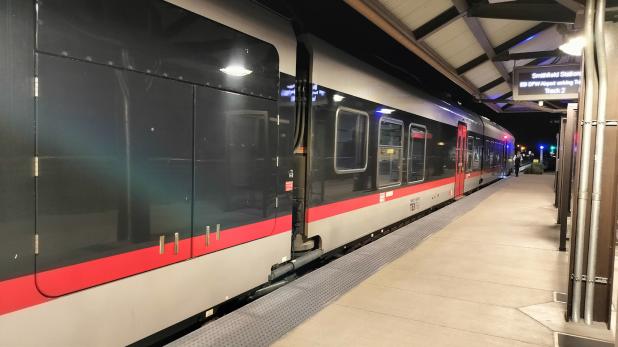
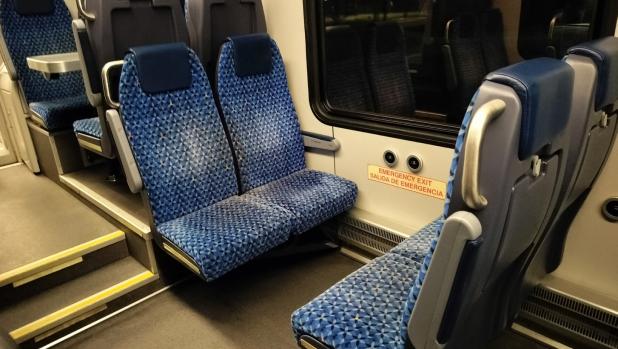
The train was clean and well-lit. There were usb ports for on-the-go charging under the windows, but I did not try them out.
Although a prerecorded message confirmed train arrivals on the platform, the communication once you were onboard was less regular. The digital screens were also uninformative. We had at least one stop between Smithfield and Grapevine that wasn’t on the online timetable. It was hard to see surroundings from a brightly-lit train car looking out into the dark, although the airport platforms were well-marked. If you’re familiar with trains elsewhere, it wasn’t the best, but it wasn’t difficult, either.
Our train flew past congestion, construction, and lane closures. Once we arrived at Terminal B, I followed the other passengers to the terminal. From there, I easily made my way through security and take the Skylink to my proper terminal. It took less than 45 minutes to depart Smithfield Station and arrive at my gate.
Parking was $5 per day, plus a $1.50 service fee. The Texrail was $2.50 each way. With a little effort and planning, this compares very favorably to terminal parking ($32/day) or even remote parking ($14/day). Keep in mind that Texrail is the light rail connecting Fort Worth to DFW Airport and runs seven days a week, and do not confuse it with the Trinity Railway Express (TRE), which connects Dallas and Fort Worth and only runs six days per week.