
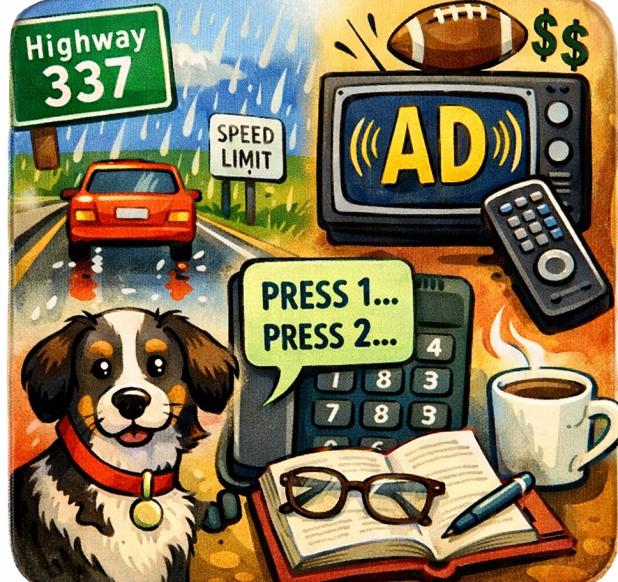
Pet Peeves
When my son headed off to college, he and our daughter rented a mobile home out in the country. With him he took his dog — his pet “Peeve.” Peeve was a mutt, a little larger than a Border Collie but not as big as a Rottweiler. My children inherited their father’s sense of humor when it came to naming pets.
I have many pet peeves — just not canine ones.
I recently traveled to Stephenville to keep the twin grandchildren while their parents attended an “adults only” wedding. On the way home, it started raining around Mineral Wells — beginning as a sprinkle, then varying between that and a full downpour all the way to Graham. By the time I reached the last leg into Olney, it was back to light sprinkles.
T he vehicles ahead of me varied speeds as I turned onto 337 toward Graham. Fortunately, the highway has been improved with passing lanes along the way. Some drivers went the speed limit — really too fast for rainy weather — while others slowed down. What stunned me was how many had no lights on. When the rain was heavy, I couldn’t see the vehicles in front of me were up close. Thankfully, I slow down when it’s raining, so I was unlikely to run into them simply because their lights weren’t on.
I make a habit of driving with my lights on whenever I’m on the road. Even though my vehicle is “electric blue” and easy to see on a clear day, headlights make sure I’m not ignored. Fortunately, my car has a setting that turns the lights on when I start it and off a little while after the engine is shut down. I don’t have to worry about forgetting.
And let me tell you, it’s inconvenient to ask someone for a jump start because you forgot to turn off your lights in a parking lot.
Then there’s television volume. Commercials are almost always louder than the program you’re trying to watch. When I was younger — at least I think I remember — the Federal Communications Commission had a rule that television commercials could not be louder than the programming. That doesn’t seem to be the case anymore. Somewhere along the line, someone either forgot the rule or convinced the FCC it should be reversed.
It’s ridiculous to keep the remote in your hand so you can lower the volume — or mute it — during commercials and then raise it again when the program returns. It doesn’t help that conversations in shows are sometimes softer than the music that’s supposed to be in the background. Some smart televisions have settings to help with this irritation, but you have to know how to find them.
Then there’s the NFL, which has decided to allow broadcasts that require paid access to football games — Prime, Apple+, Netflix, Paramount+, and probably others by now.
“Commercial television” used to pay its employees and maintain equipment by airing commercials that local and national businesses paid to run. Our own local television reception was limited, so we used cable for years. But the cable company kept raising its rates — and raising them again. With “everyone” having internet access and smart TVs, cable simply couldn’t compete.
We finally broke down and got a smart TV and internet service. For seniors who aren’t familiar with computers, setting one up can be very frustrating. Fortunately, I was exposed to computers through my job at the newspaper. Even so, I still have trouble setting up a smart TV when one needs replacing. We’re now on our third.
The first one still had cable. When the cable company raised our “subscription” to more than $130 a month, we switched to Wi-Fi. Olney is fortunate to have Brazos Telecommunications providing fiber-optic internet, so my smart TV now keeps us entertained in retirement.
Then there are the NFL “color commentators.” I don’t mind listening to Tony Romo or Tom Brady. They talk about the players on the field, the plays, and the rules — all fine by me. But there’s one commentator who is less entertaining than Howard Cosell ever was. He does pull up facts — or rather, the tech researcher whispers them into his ear — but some of what he says is just annoying and downright ridiculous. In my opinion, that network would be better off with only the play-by-play announcer.
Then there are the establishments that think automated answering machines are a good idea — the ones where you have to punch numbers on your phone just to maybe get a human being.
Not everyone phrases things the same way. I recently had to call the Social Security Administration. The recorded voice was pleasant and easy to understand. But when I told the “machine” why I was calling, it repeated the question and then gave me two choices, instructing me to press 1 or 2.
I don’t understand why an organization that deals primarily with senior citizens insists on being so automated. Not all seniors are comfortable with online communication or automated phone systems.
My frustration didn’t stop there. I finally reached the point where my issue could be discussed with a real person — after a quoted wait time of 120 minutes. Stubborn as I am, I waited. I listened to not-too-offensive music, interrupted by that same pleasant voice offering bits of information: reminders that the wait was long, encouragement to handle things online, explanations that SNAP isn’t part of Social Security, and notice of a survey I could complete after the call.
I listened for 110 minutes. Then the call disconnected. There was no survey — and no human being. After all, I never actually talked to one.