

WF Area Food Bank Sees Growing Need in Olney
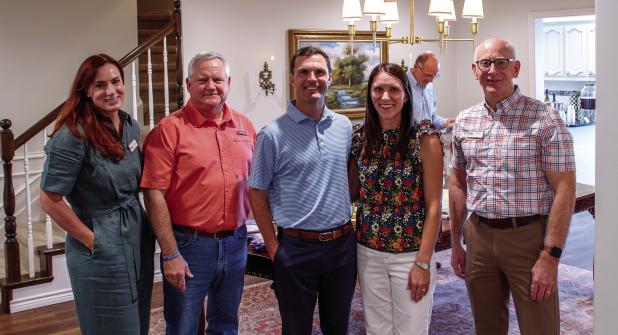
The Wichita Falls Area Food Bank brought a message of community collaboration and concern to Olney last Tuesday, June 24, during a reception hosted by Mayor Rue Rogers and his wife Anna at their home.
Food Bank CEO David O’Neil and Director of Philanthropy Julie Nawrocki met with local leaders, educators, clergy, and volunteers to highlight the rising need for food aid in Young County and the challenges ahead as federal food assistance programs face deep cuts.
Young County has one of the highest rates of food insecurity in the state at 18.7 percent, significantly above the national average of 13.5 percent. Ms. Nawrocki, citing statistics from Feeding America, emphasized that one in four children in the Food Bank’s 13-county service area—including Young County—struggles with hunger.
“We want to hear from you as neighbors,” she said. “That’s why we’re here—not just to talk about numbers, but to understand what families are really facing.”
David O’Neil, who began volunteering at the Food Bank after retiring from a career in finance, described the organization not as a traditional soup kitchen, but as a logistical hub distributing food through over 90 community partners, including local churches and schools. In Olney, partners include First United Methodist Church, Ministry of Helps, the Senior Cub Center, and House of Mercy.
A highlight of the Food Bank’s efforts is its Power Pack for Kids program, which distributes weekend bags of non-perishable, nutritious food items— now enhanced with brain-boosting ingredients like choline-fortified applesauce—to children at risk of going hungry between school meals. Last year alone, 15,000 Power Packs were distributed to Olney students.
But growing demand and shrinking federal support are stretching resources thin. Mr. O’Neil noted that U.S. Department of Agriculture food represented 24 percent of the Food Bank’s inventory last year. This year, that figure has dropped to just 14 percent due to federal budget cuts.
“We’re losing 10 percent of our food supply and having to make that up through produce and private donations,” he said.
One strategy involves switching from $30 dry goods boxes to $7 produce boxes, significantly increasing the amount of healthy food distributed. Through partnerships and innovation—such as a mobile teaching kitchen and in-person cooking demonstrations—the Food Bank is trying to break the cycle of food insecurity with education and empowerment.
Olney educators and service providers at the reception stressed the need for better communication with families, many of whom are unaware of the available resources. Others voiced concerns about language barriers, pride-related stigma, and logistical challenges that prevent food from reaching the people who need it most.
Mr. O’Neil and Ms. Nawrocki also previewed an $18.6-million expansion plan to build a new 52,000-square-foot facility with a full commercial kitchen to scale up production, food storage, and community education. The James N. McCoy Foundation has pledged $6 million toward the project.
“We hope one day to put ourselves out of business,” Mr. O’Neil said, “but until then, we need volunteers, donations, and advocates in every corner of the community.”
For more information or to support the Food Bank, visit www.wfafb. org.