Language Is Not Just Speech
I’m a Texas American. I speak English like I was taught and have a Texas “twang.” I know this because in one of my past jobs, I answered the phone and determined who the caller was and if they needed to be transferred, or if I just needed to take a message with a number.
One caller spoke very quickly with a non-accent accent. I interrupted him politely and simply said, “My Texas ears cannot hear as fast as you speak.” I must admit I laid the Texas twang on a little heavily. He was amused by my response and complimented me on my Texas accent.
In that job, my co-worker was fluent in Spanish. I learned a Spanish phrase to let a caller know I would transfer the call to someone who would understand Spanish. I did not speak any language other than Texas English.
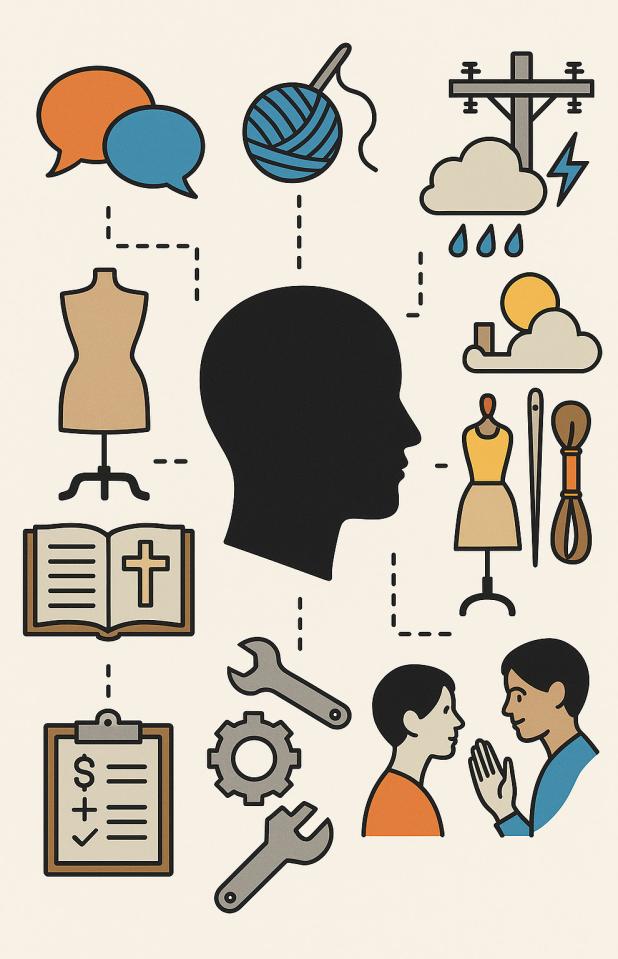
But there are other languages to which we are constantly exposed. My mother was a seamstress, and she and my home economics teacher educated me on the terms connected to sewing clothing. My grandmother taught me the language of embroidery, the types of stitches, and embroidery transfers that you could iron onto a chosen fabric. Both included the language of fabrics. My first paying job was at Haggar Slacks. I learned more specific language of sewing men’s slacks, and about my sewing machine.
Bookkeeping has its own language. Simple bookkeeping lingo, and you can get in to accounting terms. My job at the newspaper as typesetter was another language. I learned to type by the word, rather than the letter, my speed improved, too bad my typing teacher didn’t know that.
I learned to crochet from a book. Mother tried, but my left brain just wouldn’t connect with her right brain! The language of crochet is very different from the language of knitting. I tried knitting too, but I worked too tight to make pretty projects. But when it comes to crochet, sometimes I don’t even have to look at the work, I feel if it’s wrong or right.
I have been exposed to other languages. My husband has worked as a diesel equipment mechanic, and has always been able to work as a gasoline mechanic, though not a paying job. He has worked in the oil field where his mechanical skills were beneficial, but what he was working with was a whole “‘nother” language.
My husband spent 32 years working for the electric cooperative. A new language was learned, and I learned it so I would know what he was talking about. Not enough to go stand in for him, but enough to ask questions that were pertinent.
Weathermen have their own language, and to understand their forecasts we learn some of that language.
I learned a “new” language when I began attending the Lutheran church with my future husband. Very different from the Baptist churches I grew up in.
The synod (there’s a word not every one will know without looking it up) decided to update the hymnals and liturgy (another new word). I was disappointed that they wanted to change some of the language! For example, Thee, Thou, Thine changed to You and Your. I felt they were changing our worship language, and definitely took out the “poetry”. In SOME hymns that are used across the country by Christians, the poetry and reverence remained. Should I have a visitor who wasn’t a Lutheran, I would help them follow the service.
Then there is the language men use only around other men. Thankfully they don’t use it around women if we’re lucky. I didn’t want my son to learn that language until he was a grown man. Our attitude is a language as well. Some people are gentle. Some people are loud. Some people are bashful, some are outgoing. These languages are not necessarily learned, but just the way people are. Learning to understand nonverbal languages is as important as learning to talk.
We need to learn all the time, and learning different “languages” throughout our life helps keep our brains active.