
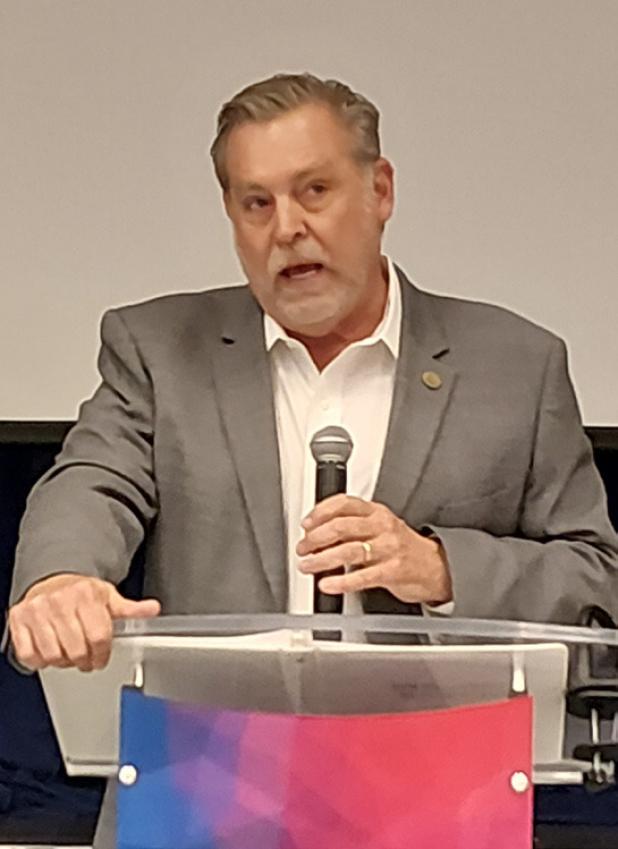
Spiller Outlines Priorities for 90th Session
Property tax relief, stronger protections for residents near data centers, and water policy will be major issues in the next Texas legislative session, state Rep. David Spiller told Young County constituents on Oct. 12.
Speaking at a Young County Republican Party meeting at North Central Texas College in Graham, Mr. Spiller also identified safeguards for law enforcement surveillance cameras and changes to the process for routing high-voltage transmission lines among his legislative interests.
The House District 68 Republican, who faces Democrat Jasmine Henderson in the Nov. 3 election, said lawmakers agree on providing additional property tax relief but have competing ideas about how to deliver it.
“We will provide meaningful tax relief,” Mr. Spiller said.
He predicted legislation addressing property appraisals and local government taxing or spending decisions, saying state leaders want to prevent local increases from offsetting relief provided by the Legislature.
“If you think that the legislature is not going to meddle in your business and tell you what you can spend money on and what you can’t, you’re mistaken,” he said he has told local officials.
Mr. Spiller qualified that prediction, saying it did not necessarily reflect his own preference.
Data center rules
Mr. Spiller said he has drafted comprehensive data center legislation addressing county approval, project locations, setbacks, water use, lighting, noise and requirements for developers to bring their own power.
The proposal is undergoing review by the Texas Legislative Council, he said, and he intends to file it when bill filing opens.
Water protections would apply even in counties without groundwater conservation districts, he said. He also encouraged officials in counties including Young County to consider whether joining an existing district would benefit residents.
Mr. Spiller said counties need ways to protect neighboring landowners without relying on tax abatement negotiations to obtain concessions from developers.
“I’m not an abatement guy. I don’t really like them,” he said.
He supported discussing broader county regulatory authority but identified political resistance to extending those powers to large urban counties, including Harris, Dallas and Travis.
“Do we bracket that and say counties, smaller counties have the authority? I’m okay with that,” he said.
Residents also questioned who would pay to remove abandoned data centers if developers failed.
Mr. Spiller compared that risk to orphaned oil and gas wells, saying operators’ bonds can fall short of plugging costs after companies go out of business, leaving the state to step in.
He said cleanup responsibility needs to be addressed for data centers, power plants, wind turbines, and solar facilities.
“If the State of Texas allowed that darn thing in, then the State of Texas needs to make sure it’s cleaned up, and it’s fixed,” he said.
In an interview afterward, Mr. Spiller emphasized that he supports protections rather than opposition to the industry.
“I think there need to be protections for people, but I’m not anti- data center,” he said. “We need to have better rules.”
Power lines and surveillance Mr. Spiller said lawmakers should examine the process for routing 765-kilovolt transmission lines, which he said could affect several counties in his district.
Additional transmission infrastructure is necessary, he said, but decisions must account for landowners’ rights and sensitive property.
“We have to do it in a responsible way,” he said.
Mr. Spiller also said he has drafted legislation concerning Flock cameras used by law enforcement. He opposed eliminating the technology, citing its usefulness in solving crimes, but said safeguards are needed.
He did not detail those proposed restrictions during the meeting.
School funding
Mr. Spiller called for continued attention to public education, teachers and retired educators.
“We’re not done,” he said of previous legislative efforts to support them.
Asked afterward about Olney ISD’s enrollment and funding concerns, he expressed reservations about increasing spending on education savings accounts, the state’s school voucher program.
“My first and foremost concern is to adequately fund public education,” he said.
Mr. Spiller said his office had contacted all 59 public school districts he represents that day, asking superintendents to identify problems and suggest legislation.
He also cautioned that shifting more school costs from local property taxes to state revenue requires a sustainable approach.
“The problem with that is that’s all well and good when you have a budget surplus,” he said. “But what happens if and when you don’t?”