
Project Saltworks Data Center Seeks Tax Abatement
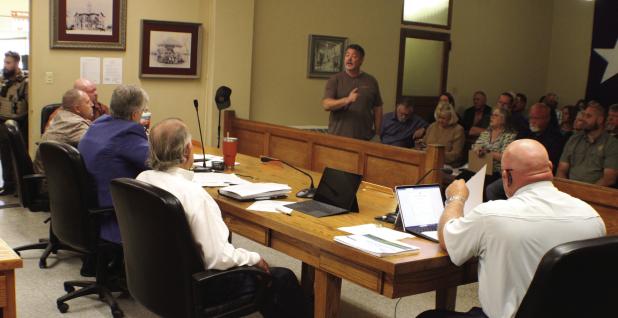
The Young County Commissioners Court received its first look at a proposed tax abatement request from Project Saltworks during its June 22 meeting, hearing from company representatives and citizens divided over the prospect of a large-scale data center located about 16 miles south of Olney.
Commissioners took no action on the proposal, instead voting unanimously to table consideration of an escrow agreement that would have allowed Project Saltworks to fund outside legal and engineering reviews of the project.
The presentation marked the first time Project Saltworks officials publicly outlined the incentives they are seeking from Young County. Representatives said they are requesting a 100 percent abatement on personal property taxes associated with equipment inside the facility and the creation of a tax increment reinvestment zone (TIRZ), with 50 percent of the project’s tax increment directed toward public infrastructure improvements in the area.
The company previously said the project could involve as many as 15 buildings, valued at between $600,000 to $1 billion each, depending on the hyperscale user.
Residents voiced concerns about water supplies, traffic, noise, impacts on wildlife, property values, and the long-term effects of industrial development in southern Young County. Several questioned whether the project would deliver the jobs and economic benefits.
Resident Karen Brewer said she was concerned about how the county would allocate water long term to the data center, as well as the water used for construction. “We can’t live if we don’t have water and this is an ongoing thing with the water,” she said. “The water’s not going to be there. You’re going to suck it all out of the ground.”
Others argued that if the data center is ultimately built, the county should negotiate aggressively.
“If we can’t make the cons outweigh the pros, there is no point in making a deal,” Debbie Rhodes said. “Stream is a reputable company and they want to be a good neighbor. So they’re going to come in and build regardless of the tax abatement, the same way they build everywhere they go because that’s their reputation.”
Matt Long of Headwaters Site Development told commissioners that the project would be located on approximately 890 acres in unincorporated Young County and is designed to serve as a large-scale data center campus. He emphasized that the development would use air-cooled technology rather than water-intensive evaporative cooling systems.
“We do not consume water in our cooling process,” Mr. Long said, explaining that the facility’s primary water use would be for sinks and toilets. He also said the company plans to coordinate road improvements, traffic management plans and environmental studies with county officials, the City of Graham and state regulators before construction begins.
Olney Economic Development Corporation executive director Tom Parker attended the meeting, commenting that “it was great to see the turnout at the Commissioners Court this morning.”
“Change is difficult for many people,” he said later. “It is important to remember land rights and why we enjoy the freedom we do in Texas. I believe this project can and will be managed by those involved with the best economic, environmental, and aesthetic outcome.”
Mr. Parker praised the negotiating skills of the commissioners and Judge Win Graham, saying, “we have great people here all working for what they believe to be the best end result.”
Project representatives pushed back on some residents’ contention that they were caught unaware by the data center proposal.
“We’ve been here for about two years now,” Stream Data Centers Chief Development Officer Oisín Ó Murchú said. “The reason we move so slowly on a project is because we see ourselves as responsible developers.”
Even so, many speakers remained unconvinced.
Project Saltworks representatives also addressed concerns about the project’s electrical demands, saying the site was selected in part because of its proximity to major transmission infrastructure. Mr. Long noted that five 345-kilovolt transmission lines run through the area, making it an attractive location for a large-scale data center campus. When questioned about whether electric infrastructure upgrades could result in higher costs for local residents, he said the project would utilize its own electrical service and said transmission improvements associated with the development could ultimately make the regional grid more reliable. The company did not disclose how much electricity the proposed campus would consume at full buildout or provide details about any transmission upgrades that may be required.
Commissioners noted that if the project proceeds without an abatement agreement, the county would not receive tax revenue until the facility is completed and placed into operation, potentially 18 months to two years after construction begins. During that period, county roads and infrastructure could still experience increased traffic and construction-related impacts.