
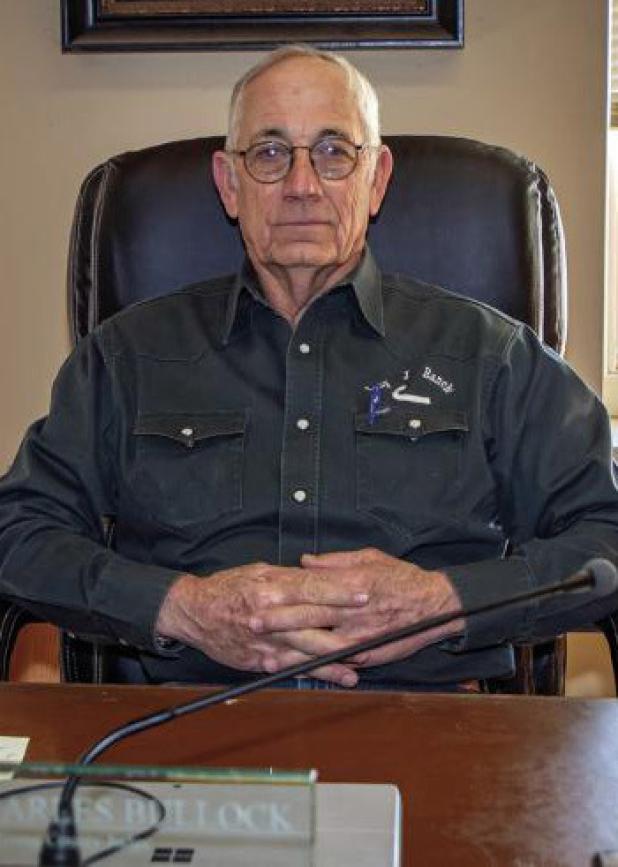
Bullock: ‘No Firm Position’ on TIRZ; No Abatements
Former Young County Judge John Charles Bullock declined an interview request from the Olney Enterprise but referred questions to statements posted on his campaign website, bringbullockback. com.
Judge Bullock, who approved four tax abatements for industrial projects during his five terms as commissioner and three terms as county judge, now says he opposes granting additional abatements for industrial projects, including the proposed Project Saltworks data center planned near Graham.
“These developments did not bring lasting economic impact to the county, [such] as in businesses, jobs, housing, or maintenance and service. Taxes did not decrease much, if any at all,” he wrote on his website. “There may have been some temporary effects during the construction phase, including impacts related to sales tax and material transportation by trucking companies, which concluded within twelve to fourteen months or less. Just a little bigger pot for the [County Commissioners Court] to spend out of.”
Young County does not collect twothirds of its taxable value each year due to agricultural exemptions, homestead caps, disabled veteran relief, over-65 freezes, nonprofit exemptions, and other deductions, giving it a net taxable value of just $1.787 billion last year, according to County Appraiser Jesse Blackmon. The county’s budget last year was $19.4 million, including $1.2 million in green energy tax abatements.
Judge Bullock said he also opposed the abatement recently granted by the Commissioners Court to the Tapaderos solar project, expected to bring $4.7 million in revenue to the county’s coffers in the coming decade “I do not advocate having any solar farms in Young County because they take away all of the productive agricultural uses.”
His statement mentioned a statistic from the American Farmland Trust, the nation’s leading farmland conservation nonprofit, that “between 2001 and 2016, in the USA 11 million acres of farmland and ranch land were converted to urban and highly developed land use … or low-density residential land use…” Judge Bullock did not mention, however, that American Farmland Trust has created a Smart Solar plan to show farmers and ranchers that “agriculture and solar energy can coexist if appropriate planning is undertaken.”
“Agrivoltaics projects sustain agricultural production underneath solar panels and/or between rows of solar panels throughout the life of the project,” the trust says in its Smart Solar brochure. Nor would Judge Bullock approve any more county abatements for wind farms seeking to locate in Young County, saying that they would probably locate here without tax breaks to get access to transmission lines.
“What draws developers’ interest most is access to high-voltage transmission lines and large blocks of land with few owners. Young County has both large-acreage owners with the transmission lines through their properties, making it a private property deal. They do not need or deserve a subsidy from the county taxpayer,” he wrote.
In 2022, Judge Bullock’s last year in office, the Commissioners Court lowered county property taxes by 15 percent despite higher property valuations thanks to revenue from the Trinity Hills Wind Farm. The Olney Independent School District realizes $1.2 million per year from wind farm projects in its taxing district, and the Olney Hamilton Hospital drew on $10 million in wind farm tax revenue to open the Olney Family Clinic in 2010. Hospital officials said they were counting on wind farm revenue to help pay back $33 million in general obligation bonds for the new hospital.
Data Center ‘Chaos’
Judge Bullock has recently joined data center opponents who have expressed concerns about the data center project’s potential energy and water use, as well as increased traffic, tighter housing, and strains on the county’s fire and law enforcement personnel. County appraiser Jesse Blackmon estimated that Project Saltworks’ $1 billion investment would generate more than $14 million in tax revenue annually for Young County, including $1.5 million for Olney Hamilton Hospital.
“In my opinion, the county is not adequately prepared for the level of chaos and challenges this development would create. I would not support an abatement on this project,” Judge Bullock wrote.
However, county officials say pressures associated with data centers planned or underway in Wichita, Archer, Jack, Haskell, and Taylor counties are already evident in Young County.
Sheriff Travis Babcock said a couple of weeks ago that the Young County jail is already housing more felony offenders than in previous years, which he attributed to workers from the Google data center in Haskell County.
He said the rapid expansion of data centers and energy-related projects in Wichita, Archer, Haskell, Armstrong, Taylor, and Wilbarger counties could intensify law enforcement challenges for Young County unless additional revenue becomes available for staffing and infrastructure.
The sheriff said the department will likely need to add patrol deputies, dispatchers, and experienced jail staff if regional growth continues at its current pace.
Judge Bullock said he would rely on grants to help the county’s volunteer fire departments afford new equipment. “I have experience pursuing federal, state, and regional grant opportunities for trucks, radios, protective gear, and communications upgrades,” he wrote.
He said he “would need to discuss directly with the sheriff ” how to increase patrol deputies and retain more jailers. “In the past, the county has received some state funding designated for law enforcement and jail staff raises, but I do not yet know whether those funds are ongoing, one-time or available for additional staffing,” he wrote. “Typically, these positions are funded through local tax dollars.”
No ‘firm position’ on Olney’s TIRZ Most concerning for Olney city officials was Judge Bullock’s statement that he does not believe counties should take the lead role in recruiting industrial development - a direct repudiation of the current Commissioners Court’s agreement to invest some county tax dollars to help Olney with a plan to grow its housing and business sectors.
The Olney City Council, Olney Hamilton Hospital, and the Commissioners Court last year approved two tax increment reinvestment zones designed to attract outside matching grants, lowcost loans, and developers to invest in the city’s dilapidated roads, crumbling water infrastructure, aging Main Street buildings, and lack of housing, with the promise of eventually being repaid by revenue from the growing tax base.
“I have not formed a firm position yet because I believe the issue is more complex than a simple yes-or-no answer,” he wrote. “It appears to be a complicated matter and, from a tax increment perspective, seems better suited for a large, densely populated area,” he wrote. “Since the county has already executed those agreements, there would be no intent to alter the TIRZ.”
However, should the county run short of funds from its failure to realize additional revenue amidst the strains on services from developments in surrounding counties, the new Commissioners Court, which already includes data center opponent Travis Kunkel, could step out of the agreement, said attorney David Earl, an attorney advising the City on the TIRZ.
Olney Economic Development Corporation Executive Director Tom Parker described Olney’s two new taxing zones as “not a ‘big city’ concept” and “a vital tool for rural survival.”
“For Olney to maintain infrastructure, support a hospital, and provide housing for the workers already coming to current employers, many of whom live throughout the region; we need these interlocal agreements to remain intact,” Mr. Parker said.
“To suggest that the county should not take a lead role in economic development ignores the reality that our infrastructure serves many Young County residents, not just those within city limits,” he said. “We have entered these agreements in good faith to build a future, and any step back from the county would be a step back for every taxpayer in Young County and those who utilize its schools, hospital and water supply.”