
Rain is a good thing?
Agricultural operations in the Texas Panhandle are adjusting to above-average rainfall over the last month that improved soil moisture profiles but is delaying fieldwork, according to a Texas A&M AgriLife Extension Service expert.
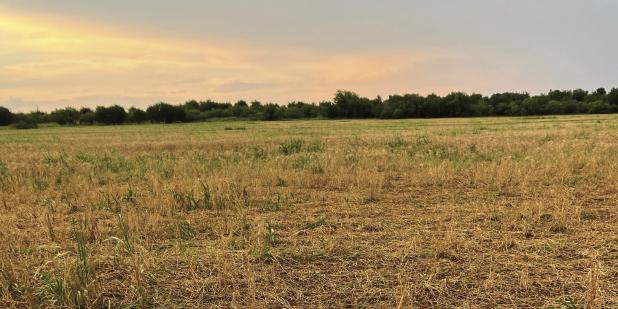
Recent rains in the Texas Panhandle have reversed much of the region’s moisture deficit brought on by several years of drought. While beneficial to the long-term prospects for agriculture, heavy rains and soggy conditions are causing planting delays for some producers and destroying crops for others.
The inability to access fields is preventing producers from planting planned crops like cotton and corn. Producers are now assessing field conditions and evaluating their planting options, said Jourdan Bell, Ph.D., AgriLife Extension agronomist, Amarillo.
Rain challenges producers in Texas Panhandle Many rainfall events around the Panhandle during May were slow, soil-soaking events that improved the soil moisture profile. Isolated heavy rainfall caused flooding, but the rainfall events that led to catastrophic flooding in towns like Hereford and Amarillo were not the norm for most of the region.
Emerged cotton plants show stress from the continually wet conditions and cooler temperatures. (Texas A&M AgriLife photo by Jourdan Bell) Precipitation has consistently fallen throughout the Panhandle since mid-May, so the region is saturated. Hereford received more than 20 inches of rainfall over one month, which is above its average annual precipitation of around 18 inches. The Hereford flooding was also caused by extreme amounts of rainfall in a short time – around 11 inches in two hours in some areas.
The Texas A&M AgriLife Research station at Bushland had received more than 10 inches over the last month, Bell said. Prior to last month, only 0.9 inch of rain was recorded at Bushland from Jan. 1-May 1.
Rainfall in June has continued that cycle. Precipitation amounts were also very sporadic, with some production areas receiving more or less than others nearby. Rain has replenished stock tanks, playa lakes and filled creeks and even lakes that Bell and others have never seen hold water.
Bell said there are still fields with standing water and crops that are likely drowned out. Other planted fields have issues with soil crusting that prevents good crop emergence. Another round of storms on June 11 and June 12 brought hail that impacted many more fields across the entire Panhandle. Cot- ton fields planted in early May are also developing very slowly because of cool conditions, provided they were not hailed out. Early planted corn looked good if not drowned or hailed out.
“Before the rain, many producers were reevaluating planting decisions because of the drought and declining groundwater, and now it’s been challenging to get in the field and get work done because of the rain,” she said. “And now we are seeing many fields that were not planted or, if planted before the rains, drowned or hailed out. It takes time for fields to dry enough to access, so the challenge for producers is to get their summer crop in before it’s too late.”
Most wheat acres failed earlier in the season due to drought, Bell said. Consistent rains throughout May likely benefitted remaining wheat fields and harvest potential, but grain yield potential was set prior to the recent rainfall.
Bell said a considerable amount of the region’s small grain crops are used for forage, and later-maturing small grain species used for forage, such as triticale, are likely to experience greater boosts in yields compared to earlier-maturing wheat varieties.