
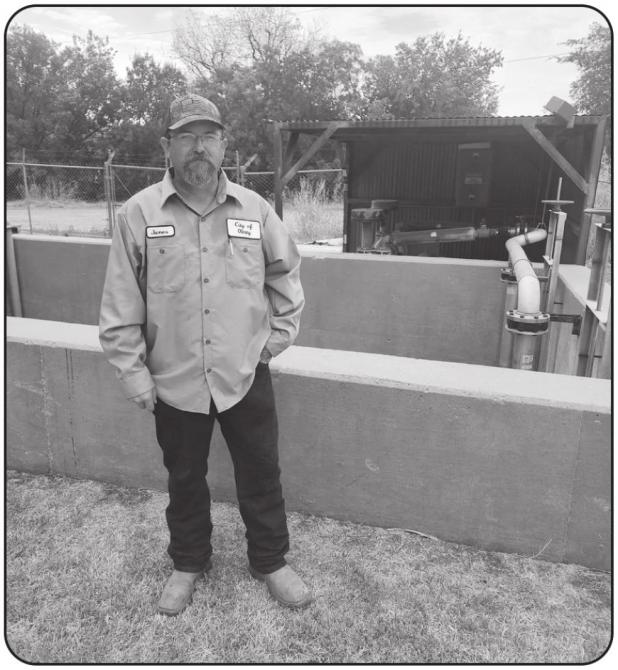
City hires new wastewater plant superintendent
The city welcomed a new wastewater treatment plant superintendent, James Mayes, who returns to Olney to operate the facility he learned the ropes on 22 years ago.
Mr. Mayes and his wife, Suzanne, the daughter of Mike and Mary Schlagel of Olney, arrived June 20 from Henrietta, Texas, where he also operated the wastewater treatment plant. Mr. Mayes said he and his wife were pleased to relocate close to family.
The city of Olney had been searching for a plant operator with a Class C license to fill the vacant post – with Public Works Director KC Blassingame filling in for three months – when Mr. Mayes spotted an online advertisement for the position.
The Class C license allows holders to make adjustments to chemicals, submit daily water tests to the state laboratory and “pretty much do everything at the plant,” Mr. Mayes said. It takes an average of two years to obtain the license, and only one other city employee besides Mr. Blassingame held one, he told the City Council in March.
The Council had explored subcontracting the plant operations to an outside firm in Graham.
A month into his tenure, Mr. Mayes said the water quality at the wastewater plant exceeds standards required by the Texas Commission on Environmental Quality.
“We are way above their standards,” he said, adding that one of the plant’s two aerators needs repair. “We have a lot of work to do it to get everything working but right now everything is working fine. Right now we are waiting for parts to get the other one [of the aerators] put back together.”
All sewer lines pour into a racetrack-shaped pond called an “oxidation ditch” at the wastewater plant, where sludge is progressively removed from the water. The wastewater is aerated and flows through debris screens into a clarifying basin and then into a chlorine contact chamber to kill harmful bacteria. Some of the treated wastewater is diverted to the Olney Country Club to irrigate the golf course, and the rest is discharged into Salt Creek.
“Once it goes in the creek it’s safe for wildlife,” Mr. Mayes said. “We always check to make sure there are no fish kills. If the chlorine gets too high we can have fish kills but we’ve never had that.”
Mr. Mayes also supervises and maintains the city’s wastewater collection system, including the town’s manholes and sewer lines. He described the system as having “trouble spots just like the water lines, but it’s really not that bad.”
“The biggest issue is people putting grease down the drains,” he said. “Every city though .. is the same way.”
He said Olney residents could make his job easier by canning their grease and throwing it in the trash, and by not dumping solvents down the drain.
“That’s the biggest thing for us,” he said. “Sometimes a chemical will come through the plant and upset this place.”