
Stream Data Center Opens Dialogue on Young County Project
A day before hosting a public meet-and-greet in Graham, the top developers behind Project Saltworks sat down with the Olney Enterprise to explain the scope, purpose, and local impact of the $1–1.5 billion data-center campus planned for Young County.
The interview featured Oisín Ó Murchú, Chief Development Officer for Headwaters Site Development and the project’s lead engineer; Curtis Miller, senior project development manager with Stream Data Centers; and Martha Cook, the project’s public relations lead.
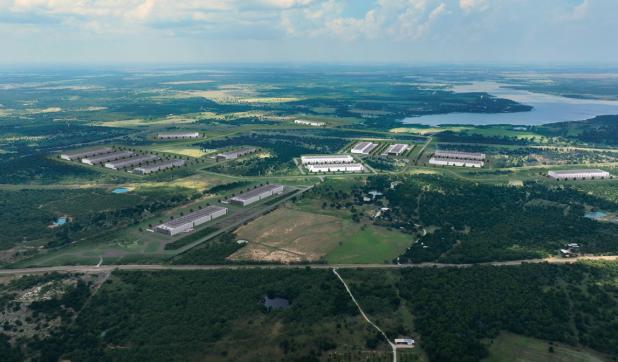
The team said the proposed development—spread across roughly 867 acres with 5 to 15 buildings built over 5 to 10 years—is moving “full steam ahead” despite social media skepticism and a contentious political climate.
Mr. Ó Murchú said Headwaters specializes in finding and preparing data-center sites for Stream or major “hyperscale” clients such as Amazon, Microsoft, Google, Meta, and Oracle. The Graham-area property stood out for its proximity to multiple high-voltage transmission lines, including 345-kV and 138-kV Oncor lines, and its reasonable distance to the DFW Metroplex.
“That confluence of energy infrastructure reduces all the investment,” Mr. Ó Murchú said. “It makes this a prime location for a data center.”
Mr. Ó Murchú said many public concerns stem from applying examples from poorly regulated developments elsewhere to a project that is designed with far stricter standards.
“There are developments out there with 10-foot setbacks from property lines and no mitigation measures,” he said. “That is exactly what we’re not doing.”
Project Saltworks intends to maintain large buffers of natural vegetation and build hundreds—sometimes over 1,000—feet from the property line. Early renderings show the campus tucked behind existing topography and tree cover.
Noise is one of the most common fears circulating on social media. To address it, Mr. Ó Murchú said the team completed a noise model and will voluntarily adopt strict limits of 55 decibels at the property line, and 45 decibels at nearby homes, levels comparable to a quiet library or the hum of a refrigerator.
Lighting, he said, would be dark-sky compliant, downward-shielded, and similar in intensity to a Walmart parking lot at night—but on a much smaller scale, given that each building would have only about 50 parking spaces.
On wildlife concerns, he said the preserved vegetation and setbacks “will protect the habitat that exists out there.”
Mr. Ó Murchú and Mr. Miller estimated that Project Saltworks’ initial phase represents $1 billion to $1.5 billion in taxable value—more than the entire current tax base of Young County.
They said the company is asking for incentives only from the county, not the hospital district or schools, which would receive full tax revenue on day one.
Mr. Ó Murchú added that data centers provide unusual long-term stability to counties because servers are refreshed every 5 to 7 years, renewing the personal-property tax cycle.
Jobs and Local Workforce Development Project Saltworks would employ 20– 30 full-time workers per building, with hundreds more working as contractors for HVAC, electrical, security, landscaping, cleaning, and small remodel projects.
Mr. Ó Murchú said his phone has been “blowing up” with messages— not from opponents, but from skilled workers wanting to return home from Abilene and the Metroplex to be closer to their families.
He and Mr. Miller also met with North Central Texas College, whose semiconductor and cybersecurity programs could be adapted to train data- center technicians. Project Saltworks will work with area school districts and local businesses on workforce pipelines, they said.
Construction Timeline and Local Presence Project Saltworks recently signed a lease on an office facing the Graham Square, staffed by a local representative who will serve as a point of contact for residents.
Site design is underway, and construction is expected to begin in early 2027, depending on final power scheduling and the selection of a hyperscale customer.
Fire Safety and Long-Term Reliability Mr. Ó Murchú said data centers are “computers in a building,” not chemical plants. Each building will include fire-suppression systems, trained operators, and a VESDA early-smoke-detection network sensitive enough to detect wildfire smoke blowing in from other states.
He said significant data-center fires are extremely rare because of the strict operational standards and the industry’s enormous investment in reliability.
“We’re Here and Accessible” Mr. Ó Murchú said the development team understands the fear of the unknown and the reluctance some residents feel about publicly supporting the project.
“We want everyone to know we’re here and accessible,” he said. “We want to make sure fear of the unknown doesn’t prevent a huge benefit to the hospitals, the schools, the local businesses, and the families who want to come back.”
Project Saltworks will hold additional open-house meetings on Jan. 13 and Jan. 29 to continue answering questions and sharing updated site information.
For more information about the project, go to the website at https:// projectsaltworks.com.