
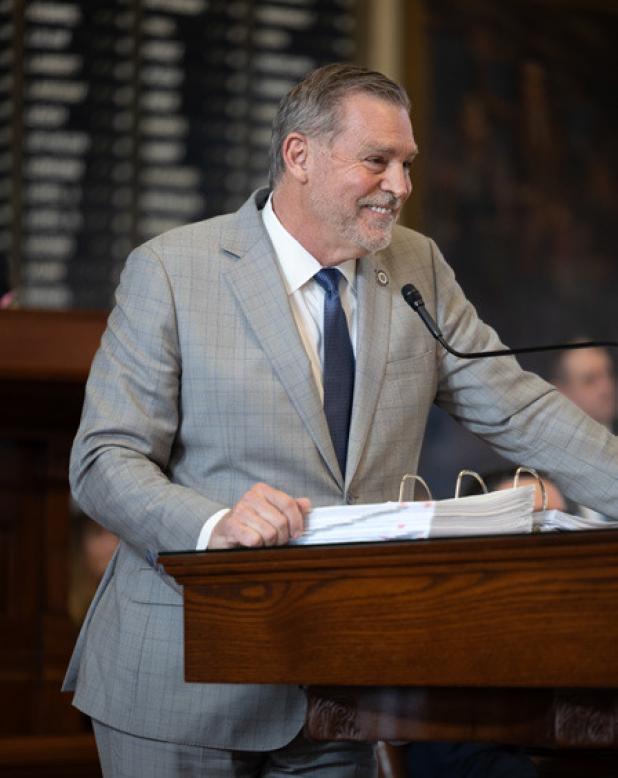
Spiller Sees Controversy Over Redistricting Comments
Texas Rep. David Spiller of Jacksboro stirred a heated debate on social media this week after appearing on a nationally broadcast podcast to defend Republican-led redistricting efforts and criticize Democrats who fled the state to block the vote.
Rep. Spiller, who represents House District 68, was a guest Aug. 5 on Washington Watch with Tony Perkins. In his interview, Rep. Spiller described the quorum break by Democrats as “a blatant violation and a slap in the face not only to all Texans but especially to those folks that we are trying to do important work in the state of Texas for, including the flood victims of Kerr County.”
He accused Democratic lawmakers of abandoning their oath of office by leaving for states such as Illinois and New York, as Republicans sought to redraw political maps in the wake of a recent 5th U.S. Circuit Court of Appeals ruling. That decision overturned decades of precedent and found that minority coalitions—such as Black and Latino voters joining together—cannot claim discriminatory gerrymandering under the Voting Rights Act.
Rep. Spiller also praised Gov. Greg Abbott and House Speaker Dustin Burrows for working with the Texas Department of Public Safety to issue civil arrest warrants for lawmakers who remained in Texas. He noted that Democrats who were found within state lines could be “handcuffed, brought to the House floor and literally locked in the building.”
The lawmaker’s sharp words drew a flood of responses on his Facebook page, where residents weighed in from multiple perspectives. One commenter wrote: “It’s gerrymandering (a long standing tactic by both political parties) in the middle between census counts (unusual) and did not come up in the regular legislative session. It’s action at the behest of the executive branch of the federal government which Texas has traditionally not been inclined to accommodate. I’d rather have districting done once every 10 years based on the census and constitutional non-partisan guidelines. I trust my state congressman from District 68 to be of high integrity with commitment to a government representative of all citizens through legal and fair voting.”
Others were more blunt. “I’m sorry some of your co-workers were dumb enough to keep you from doing your work and drawing it out,” one person posted.
A third comment criticized Republican leadership directly: “Yes!! Texas has important issues like a community devastated by a horrific flood and you all should be working on that. Instead Abbott wants to find Trump five more seats — reminds me of when Trump told the Georgia AG to find 11,780 more votes. The Democrats are doing the will of their constituents unlike the governor.”
Adding his own frustration, Rep. Spiller told listeners that the quorum break even forced him to miss a planned family trip. “I’m down here doing the work of the people of Texas and I don’t appreciate these folks sticking their finger in my eye,” he said.
The interview underscored the growing political tensions over redistricting, which could shape Texas congressional maps for the next decade. Republicans currently hold 25 of Texas’ 38 congressional seats, and the proposed maps are designed to solidify their control in most districts while leaving only a handful of competitive races in South Texas.
Analysts say the proposed map would likely give Republicans control of up to 30 of the state’s 38 congressional districts, targeting Democratic strongholds in South Texas, Dallas, Houston, and Central Texas without seriously endangering the GOP’s existing seats.
For decades, courts had allowed coalitions of minority groups—such as Black and Latino voters— to join together in lawsuits claiming that political maps discriminated against them.
But in a ruling issued on Aug. 2, the 5th Circuit overturned that precedent, holding that the Voting Rights Act’s Section 2 protections apply only to individual racial or ethnic groups, not coalitions.
The case began after Galveston County commissioners redrew Precinct 3, which had long allowed Black and Latino residents to form coalitions and elect candidates of their choice.
The new map dismantled that district, creating four precincts where white voters made up at least 62 percent of the electorate.
Civil rights groups sued, arguing the change diluted minority voting power.