
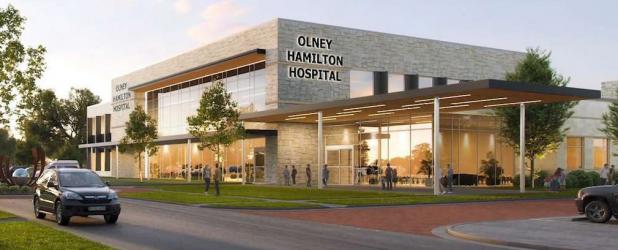
OHH board: Wind, hydrogen to pay for new hospital
The Olney Hamilton Hospital Board of Trustees wants residents to know they won’t face a tax hike to fund the $33 million cost of the proposed new hospital and has begun a public relations campaign to get the word out ahead of a Nov. 4 bond election.
The OHH board unanimously approved asking voters in the Olney hospital taxing district to approve the sale of $33 million in general obligation bonds, which will fund the new facility on West Hamilton Street across from the existing facility.
“I think we all agree that this is a generational opportunity,” Board president Dale Lovett said. “The new industries that have come to our tax district give us a financial opportunity once in a generation. The second thing is that we promised our taxpayers that they were not going to bear the brunt of anything we do. We did that before we started planning a new hospital. The typical taxpayer is not going to be affected.”
A public relations firm working with the hospital created a four-minute video detailing the case for replacing the 1927 building – added onto in 1951 and 1964 – with a new hospital whose design reflects changes in medicine and patient care, Mr. Lovett and OHH Administrator Michael Huff said.
In the video, Mayor Rue Rogers, Mr. Huff, Chief of Staff Dr. Mark Mankins, Chief Nursing Officer Samantha Webb make the case that the community depends on the hospital as much as the hospital needs the community to approve a once-in-a-generation update to its facilities.
“For the first hundred years, 80 percent of our services were inpatient,” Mr. Huff said. “[Patients] came to the hospital, they had a procedure and they stayed in the hospital. Now, it has flipflopped. Eighty percent of our services are outpatients so our new hospital is designed for outpatient services. With the vast majority of these procedures, they send you home the same day. That’s the change in the market from 1927, 1951, and 1964.”
The new facility also will include more operating rooms, a mental health accommodation room in the emergency room, an infusion area, and better infection controls as a result of the COVID pandemic, Mr. Huff said.
The hospital started taking community input about a new facility about a year ago and received enough information to come up with a budget but has yet to settle on a plan. If voters approve the bond issue, the architects and engineers will consult with the medical and administrative staff about the interior design, Mr. Huff said.
The cost of a new hospital has increased by more than 50 percent since the plan began being considered several years ago, Mr. Huff said. The cost is now about $550 per square foot, he said.
“It started out at $20 million, went to $25 million, and then to $33 million,” Mr. Huff said.
“If we don’t do something quick it will be $40 million before you can blink an eye.”
The hospital is considering reducing the new building’s footprint by moving support services, such as insurance and human resources, into a separate, lower- cost building adjacent to the hospital, he said.
“If we don’t get a new hospital, it’ll be a matter of time before the state says, ‘You’ve got to get a new hospital or you’re out of business,” Mr. Huff said.