
Iran War Spikes Fertilizer Prices, Pressures Local Growers
The fertilizer crisis shaping this year’s planting season in Young County began in a place most local producers will never see — a narrow stretch of water halfway around the world.
But the consequences of the U.S.-Iran conflict, which has closed the crucial Strait of Hormuz to shipping fertilizer, have arrived in North Texas.
Farmers in and around Olney are heading into planting season finding fertilizer more expensive and harder to source.
“It’s both,” said David Hyde, president of R-CALF USA, the nation’s largest cattle producer-only trade association, when asked whether the issue is supply or cost.
“You’re not going to be able to get it, or you’re not going to be able to afford it.”
Producers like Wil Jeske, who raises cattle and grows wheat near Olney, the price shift happened quickly and could have serious consequences in the fall growing season.
“When you’re looking at $800 a ton phosphorus… I’m not going to be able to fertilize for that high-yielding crop,” Mr. Jeske said. “So you’re starting off behind.”
According to a report from the International Food Policy Research Institute (IFPRI), as much as 30 percent of global fertilizer trade and roughly 20 percent of liquefied natural gas — a key ingredient in fertilizer production — typically pass through the strait.
With shipping restricted and production facilities damaged, prices for both energy and fertilizer have surged.
“Higher prices could reduce fertilizer use and lower crop yields if the disruption persists, posing significant food security risks,” the report warned.
In recent years, the Persian Gulf accounted for 36 percent of global urea exports, 29 percent of ammonia exports, and more than a quarter of key phosphate fertilizers. All of those products depend heavily on natural gas. When gas shipments slow or prices rise, fertilizer production becomes more expensive — or stops altogether.
Geopolitical analyst Peter Zeihan reported this month that roughly a third of global ammonia production has effectively gone offline with the conflict.
Countries that depend on imports — including major agricultural producers like India and Brazil — are now competing more aggressively against U.S. farmers for limited supply.
“A lot of the fertilizer that we get in this country is imported,” Mr. Hyde said. “What fertilizer that is out there… is getting in a bidding war.”
For American farmers, the fertilizer shock is landing on a market that has been shifting for years. The tariff war launched last year by the Trump administration disrupted long-standing trade relationships, particularly with China, once the largest buyer of U.S. soybeans. In response, China invested heavily in Brazil, improving infrastructure and expanding production, Mr. Hyde said.
“Brazil is actually kicking our butt,” Mr. Hyde said. “They can produce soybeans better and cheaper… and China has invested a lot of money in their ports.”
For U.S. producers, that means tighter margins and less flexibility as input costs are rising.
The speed of the fertilizer price increases has surprised even experienced producers.
In Mr. Hyde’s region of eastern Ohio, prices jumped from $500–$600 per ton to $800 almost overnight — and continued climbing.
“I bought mine for $800,” he said. “The next day it was $850… and last week it was approaching $1,000.”
That rapid escalation is now being reflected across Texas.
Economists with Texas A&M AgriLife report that anhydrous ammonia rose from about $840 per ton in late January to roughly $1,100 by early April, while urea prices have climbed about 48 percent since the beginning of the year.
“These are significant increases, especially when commodity prices are flat or declining,” AgriLife economist Luis Ribera said.
For Young County producers, distance from major transport hubs adds another layer of cost, with fuel prices — also tied to the conflict — pushing transportation expenses higher.
“Most producers are not at a break-even point under these costs-versuscrop price conditions,” Mr. Ribera said.
For ranchers, the effects are less immediate
Higher fertilizer costs translate into more expensive hay and feed. Trade disruptions have reshaped beef markets. Regulatory pressures continue to mount.
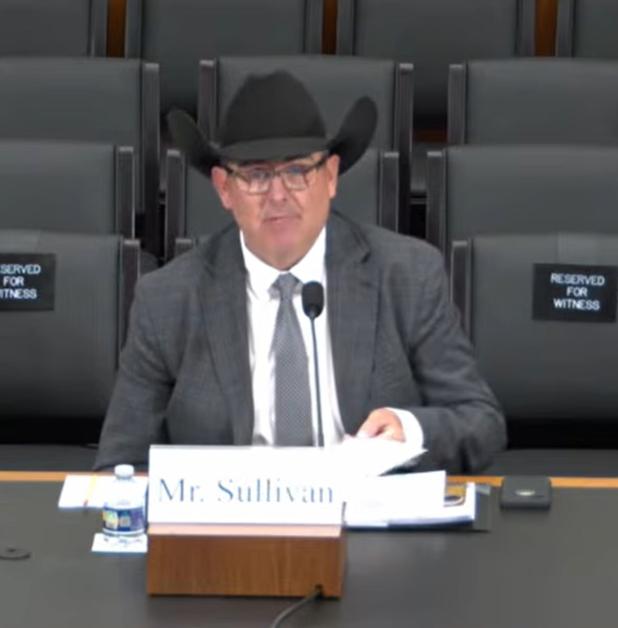
Olney cattle rancher Shad Sullivan, who also acts as R-CALF USA’s property rights chair, testified before Congress this week, described the cumulative effect.
“Across the country, we are seeing… operations pushed out through what can only be described as death by a thousand cuts,” he said.