Iran War Hits Local Manufacturers
Half a world away from Olney, the U.S.-Iran conflict is reshaping operations at two of the town’s largest manufacturers, and has a third closely monitoring the situation.
Executives at Tower Extrusions and PSI Industries say the ongoing conflict involving Iran — and the disruption of shipping through the Strait of Hormuz — is tightening global aluminum supplies, driving up prices, and forcing local plants to rethink how they operate.“It’s really hard for me,” said Mark McClelland, president and chief executive of Tower Extrusions. “I worry about supply — not next month, but third quarter,
fourth quarter. Are we gonna have enough aluminum?”
The Middle East plays an outsized role in global aluminum production because it has abundant natural gas that is needed to convert bauxite into aluminum through massive smelting operations that consume enormous amounts of electricity. Countries along the Strait of Hormuz have built some of the world’s largest smelters by leveraging their natural gas reserves, essentially turning energy into exportable metal.
“It’s a way for those countries to export natural gas,” Mr. McClelland said. “They take the natural gas, they turn it into electricity, they take the electricity, they make aluminum, and they ship the aluminum out.”
That concentration of production makes the region critical to the global supply chain. Mr. McClelland said a significant chunk of the world’s aluminum supply flows through the Strait of Hormuz alone, tied to those massive plants. When that pipeline is disrupted — whether by conflict, shipping blockades or damage to facilities — the effects ripple worldwide.
“You’ve got a quarter of the free world’s aluminum… shut down,” he said.
Because aluminum production cannot be quickly restarted once halted — smelters can literally freeze when power is cut — the disruptions create prolonged shortages that drive up prices and force manufacturers like Tower and PSI to compete for a shrinking global supply.
“There’s nothing coming in and there’s nothing going out,” he said of the shipping lane, which has been closed since roughly March 4.
The situation has been compounded by damage to major smelting facilities in the region. Mr. McClelland described how one of the world’s largest aluminum plants was knocked offline — and not in a way that can be quickly reversed.
“It’s at least a year… a year and a half to get that plant fixed.”
That disruption has created what he called “a huge hole” in the global supply chain, sending prices sharply higher. Primary aluminum, he said, has climbed from around $1.50 per pound a year ago to roughly $2.77.
“And I think it’s going higher,” Mr. McClelland said.
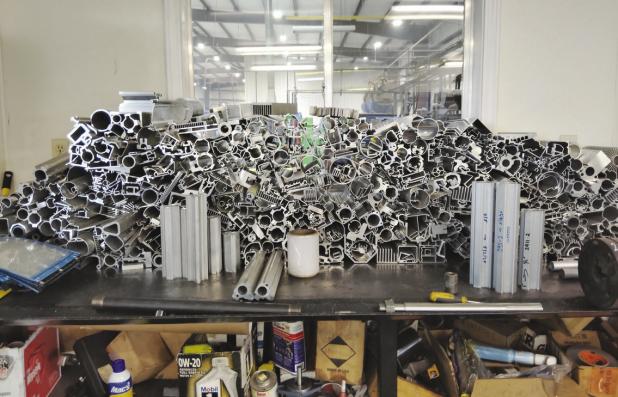
Mr. McClelland has responded by stockpiling scrap aluminum to hedge against future shortages.
“You’ve probably seen around my plant, I got all kinds of scrap,” he said. “I’m buying that because I want to make sure I’ve got enough supply in place.”
Even with those precautions, the uncertainty is affecting customers across the supply chain.
“All of our customers… their product’s getting more expensive,” he said. “It’s harder for them to finance their business… pretty soon it drains them on paying their bills.”
Across town at PSI Industries, president Kyle Coates described a similar squeeze — though from a slightly different angle.
His company, which produces smaller, specialized aluminum parts, has been forced to change suppliers and rethink its entire purchasing strategy as tariffs, shortages, and global instability ripple through the market.
“In the past, we had kind of two choices,” Mr. Coates said. “Now… we just had to change vendors because of the tariffs.”
T hat shift has made the supply chain more fragile and more expensive. Where PSI once relied on steady, scheduled deliveries, it now has to buy material months in advance and absorb disruptions when they occur.
“Right now we’re having to pre-buy three months ahead,” Mr. Coates said.
Weather delays, shipping bottlenecks, and global shortages have all compounded the problem.
“There’s just more shortage of aluminum in the world,” he said. “Everybody… is trying to grab it from all these new different places.”
Like Tower, PSI has had to pass those higher costs on to customers.
“Let’s just say we were buying it for a dollar, now we’re buying it $2,” Mr. Coates said. “That goes to them.”
At the same time, demand for domestic manufacturing has surged, driven in part by trade policy and efforts to bring production back to the United States.
The result is a paradox: business is booming, but raw materials are harder to secure.
“We’ve had record month after record month of sales this year,” Mr. Coates said. “The only… problem is… now we’re having a hard time getting enough metal to support the orders fast enough.”
For both executives, the immediate concern is how long the disruption will last.
“We need to get that strait open quick,” Mr. McClelland said.
Mr. Coates echoed that urgency, noting that even temporary disruptions can have long-term consequences in an industry where supply chains are tightly calibrated.
“It doesn’t sound like it’s gonna be soon enough,” he said. “But sooner the better.”
At Air Tractor, the world’s top producer of general aviation turboprop airplanes, president Jim Hirsch said his company was monitoring the effects of the Trump administration tariffs.
“Because our aluminum is almost exclusively American-made, these tariffs currently pose no significant threat to our production,” Mr. Hirsch said in a statement. “We are monitoring the market for minor fluctuations in international specialty steel, but our core domestic sourcing keeps us well-positioned.”