
Hospital Considers Revamping Original 1927 Building
The Olney Hamilton Hospital Foundation’s board of directors said they would consider helping raise money for a plan to convert the 1927 hospital building into administrative offices and residential dorms for medical students and staff.
Members of the OHH board told the Foundation that the plan could free up space inside the new hospital for expanded medical services.
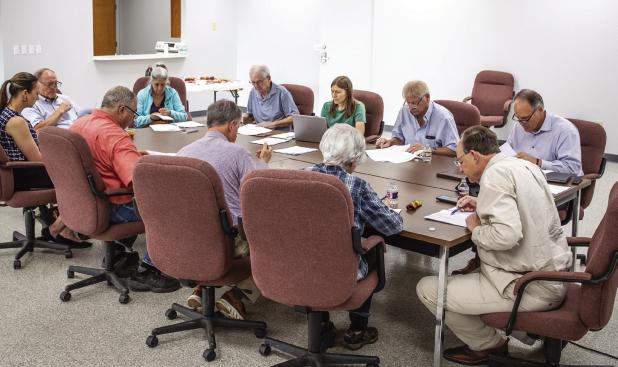
During the OHH Foundation’s annual meeting on April 13, OHH board chairman Dale Lovett and board member Lyndsey Miller presented several paths forward, including renovating the original 1927 hospital building, constructing a new facility or making limited upgrades to existing space.
By relocating administrative offices from the new hospital, Mrs. Miller said they could free up valuable square footage for patient care — potentially enough to add a second operating room.
That expansion could directly impact local healthcare access, including expanding mental health and other services, they said. Plans for the new hospital, which is nearing completion on West Hamilton Street and Avenue M, originally included an administration building and two operating rooms. Both components were dropped as construction costs rose.
“We still have a need for meeting spaces,” OHH board chairman Dale Lovett said, noting the hospital continues to house administrative offices, sleep study rooms, and other non-clinical functions in older facilities.
T he OHH board wants to use federal tax incentives to help offset the cost of renovating the 1927 building, specifi- cally through a version of New Market Tax Credits tied to historic structures.
The hospital has already successfully used the broader program once, generating roughly $3 million by leveraging past operational expenses.
Mr. Lovett said the credits under consideration would apply specifically to historic buildings, making the 1927 hospital a potential candidate if it is restored rather than demolished. That possibility gained traction after a preservation architect who examined the structure earlier this month concluded the building remains in excellent condition and suitable for renovation.
The architect specializing estimated the cost of restoration between $3.9 million and $4.9 million.
The proposal is tied to a potential partnership between OHH and Texas Tech University that would bring medical students and residents to Olney for rural training.
Under that model, the renovated building could serve a dual purpose — housing students on the upper floor while providing office and classroom space below. Mrs. Miller and Mr. Lovett said the proposed collaboration could help address one of rural healthcare’s biggest challenges: recruiting and retaining medical professionals.
OHH Foundation president Mark McClelland said the concept could present a compelling case for donors, particularly compared to raising funds for the already- financed hospital construction.
“If we’ve got a project like this … it is a great story to go sell,” Mr. Mc-Clelland said.
While no formal commitment was made, foundation board members indicated a willingness to consider helping raise funding or providing bridge funding for the renovation project to avoid saddling the hospital with more debt.
“We would rather have the foundation find the money, raise the money … rather than going out and finding money from another organization,” Mr. Lovett said.
Mr. McClelland said that the foundation would first need assurance that the hospital’s primary construction project remains financially secure before taking on a new fundraising effort.
Hospital leaders said the proposal remains in early stages, with additional work needed to refine cost estimates and solidify partnerships.
A visit from Texas Tech representatives is scheduled in May, which officials said will help determine whether the training program — and the building project tied to it — can move forward.