

Data Center Foes Skip Olney Debate
The Young County runoff debate held April 28 at Hudson’s on Main drew a standing- room-only crowd, but for much of the night, the focus was not on a clash between opposing candidates.
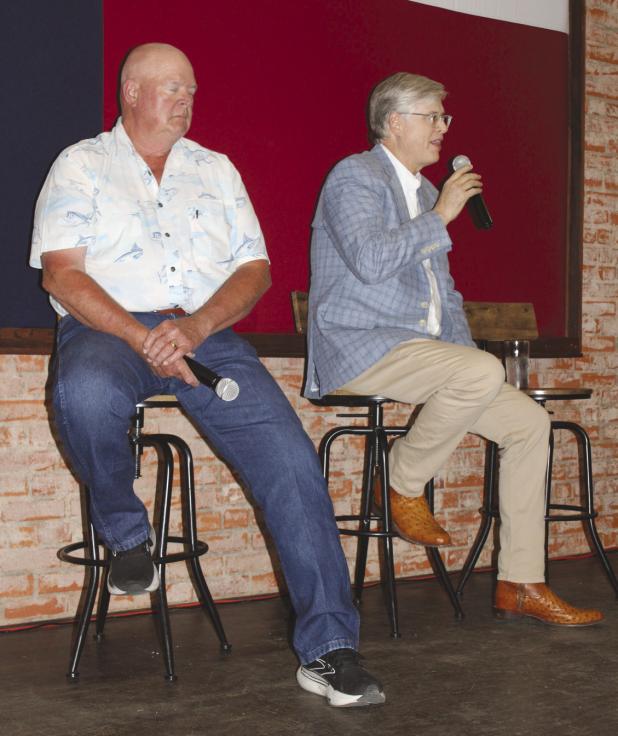
Instead, with two candidates absent, the forum became an extended public questioning of incumbent County Judge Win Graham and Precinct 4 foreman and commissioner candidate Bobby Swetnam, offering voters a detailed look at how each man views the county’s future.
Originally scheduled as a four-way debate, the event proceeded without County Judge challenger John Charles Bullock and Precinct 4 candidate Cooper Dodd, both of whom have centered their candidacies around opposition to the Project Saltworks data center. Moderator Krisa De La Cruz instead fielded nearly two hours of questions submitted by residents, many of them centered on emergency services, law enforcement funding, and the potential impact of large-scale development projects.
The crowd — made up of residents from Graham, Olney, and across Young County — filled the venue beyond capacity, with attendees standing along walls and crowding the bar area. Also in attendance were several of the county’s elected officials, including District Attorney Dee Peavy, Sheriff Travis Babcock, and Precinct 3 Commissioner Alan Craig, along with leaders from the City of Olney, such as Assistant City Attorney Dan Branum and Olney ISD Board of Trustees president Summer Branum.
Some Olney officials have publicly expressed support for industrial development efforts in the county, including the proposed data center, solar projects, and other large-scale investments, adding another layer of interest to the discussion as questions repeatedly returned to growth and its potential impacts.
Judge Graham, the 55-yearold incumbent, leaned heavily into his record and repeatedly returned to a central theme: the county’s limited tax base. Mr. Swetnam, the longtime road foreman and community figure, focused more on his experience, his service on the Loving Volunteer Fire Department, and incremental improvements, often grounding his answers in personal history and hands-on work across the county.
On emergency management — one of the first major topics — Judge Graham acknowledged it was an area he had to learn quickly upon taking office.
“Emergency management was probably the one thing that I was the most nervous about when I took this job… it’s because I didn’t really know much about it,” he said, describing how outdated county plans were when he took office.
He outlined steps taken to modernize those plans, including updating outdated contacts and coordinating agencies that previously operated in silos. He also emphasized improving communication between departments.
“What I implemented is I created a text group where I put all the chiefs of the volunteer fire department… the sheriff… the emergency management coordinators… and we had this group text,” Judge Graham said, describing early challenges getting participation but eventual improvement.
Mr. Swetnam approached the same topic from a boots-on-theground perspective, drawing on decades of volunteer fire service.
“I’m very proud to be a part of those guys… we have some great guys that are out there,” he said, while stressing the need for more volunteers and updated equipment.
He emphasized the realities of rural emergency response, where departments rely almost entirely on volunteers and donations.
“No one gets paid. Everything that we do is done by donation,” Mr. Swetnam said.
Questions about law enforcement staffing revealed one of the clearest philosophical throughlines of the night. Judge Graham repeatedly tied the issue to revenue constraints, arguing that without new sources of income, expansion would be difficult.
“The one thing that prevents us from having more deputies is budget… our budget primarily comes from tax revenues,” he said.
He suggested that large-scale development — including potential industrial projects — could provide the kind of tax base needed to expand services.
“If we could get a new corporate taxpayer… I would use that to create 10 new deputy positions,” Judge Graham said.
Mr. Swetnam agreed on the need for more deputies but framed the issue through local conditions and economic limitations.
“Young County is a hard place to get to… if you drive to Olney … Graham … or Newcastle, you meant to go there. You don’t just pass through that,” he said, pointing to geographic challenges in attracting industry.
He also highlighted rising costs tied to mental health calls and the strain those place on the sheriff ’s budget.
The proposed data center project — though its most vocal opponents were not present — remained a central issue throughout the night, drawing repeated questions from the audience.
Mr. Swetnam took a cautious, middle-ground stance.
“Do I want a data center? No, I don’t. If a data center comes here, am I gonna have a fit? No, I’m not,” he said, acknowledging both economic potential and uncertainty.
Judge Graham, by contrast, offered a detailed economic case for considering the project, emphasizing its potential to transform the county’s tax base.
“It would be a massive $10 billion investment… we could eliminate residential county taxes,” he said, outlining a scenario in which new revenue could offset property taxes for residents.
At the same time, he acknowledged drawbacks, including infrastructure strain and long-term construction impacts.
“It would be incredibly taxing to our infrastructure… to our sheriff ’s department and our roads,” he said.
Moments of levity punctuated the otherwise policy-heavy evening, often easing tension in a packed room. When asked how to reduce county debt — which currently stands at zero — Judge Graham deadpanned: “Young County’s debt is zero… I’m happy with zero,” prompting laughter from the crowd.
Mr. Swetnam drew laughs as well when joking about time limits during his answers.
“I always got the report card that says, talk too much,” he said after running long on a response.
Both candidates closed the night by grounding their campaigns in personal connection to the community. Judge Graham framed his service as an opportunity to give back.
“This is… public service and it is a way to try to give back to the community,” he said.
Mr. Swetnam emphasized generational ties and a desire to preserve what previous residents built.
“My roots run very deep… I want to continue what they started,” he said.