
Data Center Appraisal Shows $14 mln Gain for County, $1.5 mln for OHH
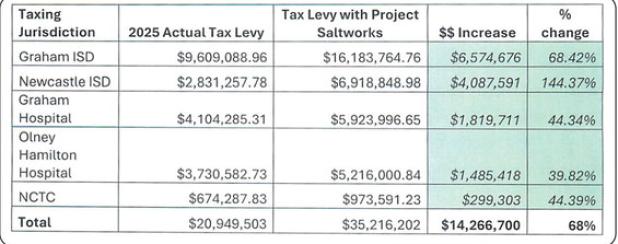
A proposed data center in Young County could generate an estimated $14.27 million per year in new tax revenue for local school districts and hospital systems, according to figures prepared by Young County Chief Appraiser Jesse Blackmon.
The estimate is based on an assumed $1 billion initial investment by Project Saltworks and does not include county taxes, abatements or payments in lieu of taxes (PILOT agreements), which the company has not yet sought.
According to Mr. Blackmon’s appraisal summary, Graham ISD’s tax levy would increase from $9.6 million to $16.18 million — a projected annual gain of $6.57 million, or 68 percent.
Newcastle ISD would see the largest percentage increase. Its current levy of $2.83 million would rise to $6.91 million, an increase of $4.08 million, or 144 percent.
Hospital districts would also see significant gains. The Graham Hospital District levy would rise by an estimated $1.82 million annually, while the Olney Hamilton Hospital District would increase by roughly $1.49 million. North Central Texas College’s local levy would grow by nearly $300,000.
In total, Mr. Blackmon projects that combined annual tax revenue would increase from approximately $20.9 million to $35.2 million — a 68 percent overall jump.
“These are not our numbers,” said Andy Jones, a community development representative working with Project Saltworks. “They are the Young County Appraisal District’s numbers.”
Since state law prohibits school districts and hospital districts from granting tax abatements, those entities would collect the full appraised value. Any abatements or PILOT agreements would involve the county or potentially the City of Graham.
City of Graham officials have discussed aspects of the project in closed session, though details have not been released publicly.
Project representatives estimate ground could be broken on the data center buildings as early as mid-2027, though no final development agreements are in place, Mr. Jones said. Construction of the first buildings would likely take several years and could include as many as 15 buildings.
“That’s just the initial number,” Mr. Jones said. “If the investment grows, the tax base grows.”
The appraisal arrives at a time when local hospital systems and school districts face financial pressure.
Olney Hamilton Hospital discontinued labor and delivery services last year and continues to carry bond obligations tied to its new facility. OHH was counting on tax revenue from a wind farm and hydrogen plant to repay the $33 million in general obligation bonds and had pledged not to raise taxes on Olney residents. When the wind farm won a court fight over its tax appraisal and the hydrogen plant pulled out of Young County, the district’s ability to service debt without additional revenue became unclear.
The projected increase would not solve all fiscal challenges, but it would materially expand the tax base across multiple districts.
Mr. Blackmon’s summary notes that the expanded tax base could help moderate future tax rate increases on residents and existing businesses.
The data center project has drawn vocal opposition from landowners and residents in south Young County, where it will be located on an 800acre parcel of farmland. Opponents say the project could strain the electric grid, drive up power prices, or increase water consumption.
Mr. Jones said the proposed facility would operate with backup generation and a closed-loop cooling system designed to recycle water rather than rely on continuous evaporation.
Under Texas grid protocols, large industrial users can be required to shift to backup generation during grid stress events, reducing strain during peak demand.
Mr. Jones also noted that the project would not be fully operational for several years, allowing time for infrastructure planning and potential grid upgrades.
Before any construction begins, the project would require additional agreements involving utilities, infrastructure and potential annexation discussions with the City of Graham. Commissioners Court action would be required for any county-level tax incentives.