
County Commissioners Signal Support for TIRZ 2
The Young County Commissioners Court signaled its support last week for participating in the City of Olney’s industrial Tax Increment Reinvestment Zone, or TIRZ, tentatively approving the concept and inviting Olney Economic Development Corporation Executive Director Tom Parker to return with formal documents for signature at the court’s next regular meeting.
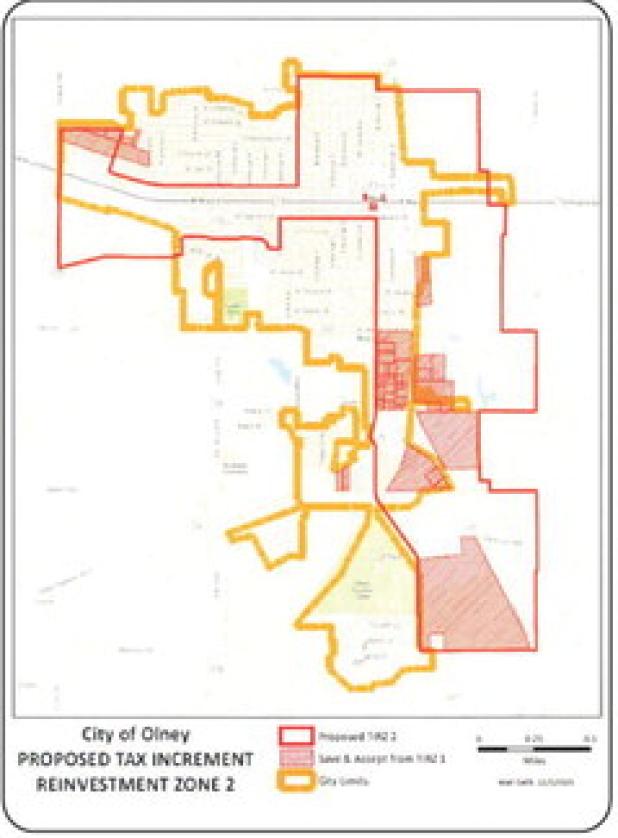
Mr. Parker presented the proposal during the Feb. 9 meeting, using a large map to outline the 1,275-acre footprint that would make up what is being called TIRZ 2. The red boundary marks the zone itself, which includes land both inside and outside the Olney city limits.
“A tax incremental reinvestment zone is not a new tax,” Mr. Parker told commissioners. Instead, he said, it is a mechanism that allows taxing entities to dedicate future increases in property tax revenue within a defined area to a separate fund used strictly for infrastructure and redevelopment projects inside that footprint.
Existing tax revenues would remain untouched, Mr. Parker said. Only the additional value created by new development or rising appraisals within the zone would flow into the TIRZ fund.
Under the proposal, the County would participate at 100 percent of the incremental increase for the first 10 years, 75 percent for the next 10 years, and 50 percent for years 30 through 45.
Commissioners would continue collecting their base tax revenue from properties within the zone, Commissioner Stacy Creswell clarified. The only portion redirected would be the growth above the established base year value.
The TIRZ board would consist of seven members — two appointed by the City, two by the Olney EDC, two by the County, and one by the Olney Hamilton Hospital district, if it chooses to participate. Judge Graham said it made sense for the Precinct 3 commissioner to serve on the board, given that Olney falls within that precinct, with a second county representative to be determined.
Mr. Parker emphasized that the zone does not automatically annex County land into the City. While some areas may eventually seek annexation as development occurs, land outside the City limits would remain County property unless landowners petition otherwise.
The footprint includes redevelopment areas inside Olney city limits, blighted residential blocks, and outlying acreage identified for potential longterm water capture and infrastructure projects tied to state water development funding.
Mr. Parker described the TIRZ as a tool to spur housing and business growth, particularly workforce housing. He pointed to vacant and underutilized properties — including the long-empty Olney Savings building — as examples of sites that could see dramatic increases in taxable value if renovated.
“If we put a roof on it and clean it up, it goes from $48,000 to $2.5 million,” Mr. Parker said. .
The TIRZ 2 board would determine which projects qualify for funding, but state law limits expenditures to infrastructure-related purposes. Funds could be used for utilities, roads, and other capital improvements, though not for general operating expenses.
If growth does not materialize, Mr. Parker said the participating entities retain the option to dissolve the TIRZ, provided no active project commitments are in place.
Commissioners tabled final action until their next meeting, when Mr. Parker is expected to return with draft agreements outlining the county’s role and representation on the TIRZ board.