
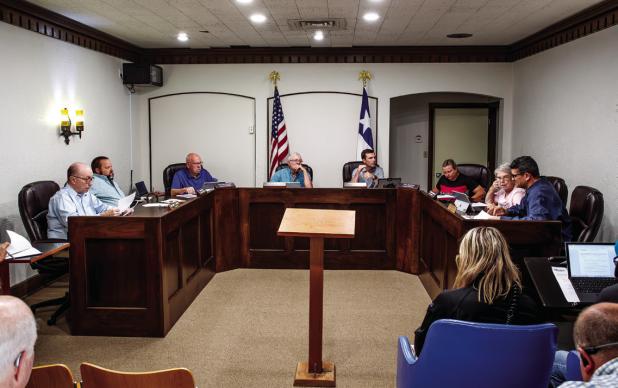
Council to Rework Permit Structure
The Olney City Council began the process of simplifying the city’s permitting structure, moving toward a flat-rate system aimed at cutting red tape, reducing confusion, and recovering inspection costs.
“We want this to be good for everybody,” said Mayor Rue Rogers, who led the discussion at the June 9 meeting. “We’re not married to this code. It’s not the end-all, beall. We’re asking for feedback and we appreciate it.”
The conversation was sparked by issues faced by local contractors and comments by Olney Economic Development Corporation board president Johnny Moore, who said the current fee schedule is not only difficult for residents to understand, but also complicated and inconsistent to apply.
The current system is based on square footage, modeled after the City of Wichita Falls. City Administrator Simon Dwyer acknowledged that the system is “not easy for the citizens, and it’s not easy for us.”
Mr. Dwyer conducted a regional review of other cities’ permit models—including Graham, Jacksboro, Archer City, and Breckenridge— and identified three main approaches: square footage- based, valuation-based, and flat-rate structures. The most straightforward, he said, was Jacksboro’s two-page flat-rate code, which sets fees like $50 for small residential construction and $500 for projects over 2,000 square feet.
“We don’t need to be charging more than we need to,” Mr. Dwyer said. “But we would like to be good stewards of residents’ money by at least covering the cost of inspections.”
Olney outsources inspections to a licensed contractor from Wichita Falls, paying $100 per trip plus $50 per inspection. Mr. Dwyer noted that trying to recoup those costs under the existing model is nearly impossible when permit fees are low and unpredictable.
The Council, along with citizens and staff, also debated what kinds of work should trigger permits. Concerns were raised that the ordinance is unclear about the difference between routine maintenance and structural renovations.
Resident Cindy Moore said any new ordinance needs to “be really clear that repairs and maintenance do not require permits.”
City Council members echoed the need for simplification. Councilman Ronnie Cowert said, “I haven’t been a fan of that since I got on the council. I think I voiced that. It doesn’t fit Olney.”
Councilwoman Thea Sullivan and Councilman Steve Nurre also endorsed a flat-rate model, with Mr. Nurre emphasizing the need to define key terms like “repair” and “remodel” in the revised ordinance.
Mr. Dwyer said a flatrate schedule for residential projects is “completely doable,” though commercial projects may still require more flexible structures due to their size and complexity.
Mr. Nurre and Mr. Moore volunteered to work with city staff to draft a new flat-rate schedule with clear definitions with the goal of presenting a new ordinance for a first reading at the next meeting.