
Council Considers Higher Fees for Food Trucks
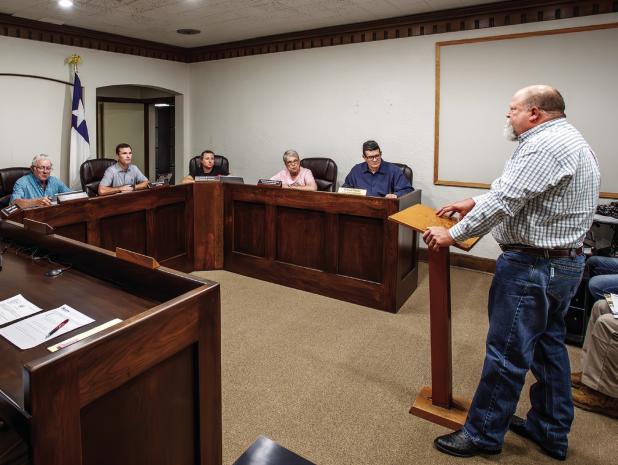
Barry Hodges, co-owner of Big Luv’s BBQ in Olney, asked the City Council on June 9 to consider increasing food truck fees and tightening regulations, arguing that mobile vendors are cutting into the revenues of brick-and-mortar restaurants without sharing the financial burden of doing business in the city.
“First of all, I want to clarify—I’m 100 percent for food trucks,” Mr. Hodges told the council during the public comment portion of the June 9 meeting.
“I support and go to them when they’re here. But the restaurant business is a very low-margin business. You can run great volume and it looks like you’re making a lot, but at the end of the day, it’s a very, very tight business.”
Mr. Hodges said that on days when popular food trucks operate in Olney, his restaurant can lose up to 10 to 20 percent of its daily revenue.
“I wish the council would make it where I paid $100 a year to have my business here and that was all I had to do,” he added, noting that in addition to sales and property taxes, brickand- mortar restaurants face utility fees, trash surcharges, and other fixed
costs.
“We just took a 30 percent increase on the commercial side of the trash business. That was my increase.”
Currently, Olney charges a $100 annual permit fee for food trucks and $50 for a sixmonth permit, allowing trucks to operate as often as they want during that time.
Mr. Hodges, who moved to Olney from Fort Worth and invested in a permanent location, said that policy creates an uneven playing field.
“They can come in, set up a couple of picnic tables, and basically do what I do—but without any of the overhead,” he said. “If they’re allowed to set up picnic tables, what’s the difference in what I do? I don’t have indoor dining either. I have picnic tables only.”
Mr. Hodges said he reached out to several nearby communities— including Jacksboro and Graham—to compare policies.
Jacksboro, he said, charges $50 per day, $100 per week, or $300 per month, and hosts food trucks in a designated park with water and electric hookups. That facility is privately run.
“I’m still kind of curious how the city is telling people you have to go there if it’s a privately owned business,” Mr. Hodges said, “but that’s neither here nor there. That’s what their current fee is.”
He proposed that Olney adopt a tiered structure: $40 per day, $100 per week, or $225 per month. He added that the City could consider reduced rates for special events or single-day appearances like those at the Olney Country Club.
Mr. Hodges also expressed concern that the City allows food trucks to remain in town for extended periods without additional oversight.
“Currently, there’s been a food truck… at the bank for almost two weeks,” he said. “It’s not there today, but I talked to the owner—he’s a client of mine—I do business with him several times a week. I told him what my proposals were.”
Mayor Rue Rogers responded with appreciation for the presentation.
“We appreciate you coming and signing up and sharing that, doing your homework, and giving us something to consider,” he said.
The council took no immediate action but is expected to revisit the food truck ordinance in upcoming meetings as part of a broader review of vendor policies.