
Bidders, City Prepare for Water Study
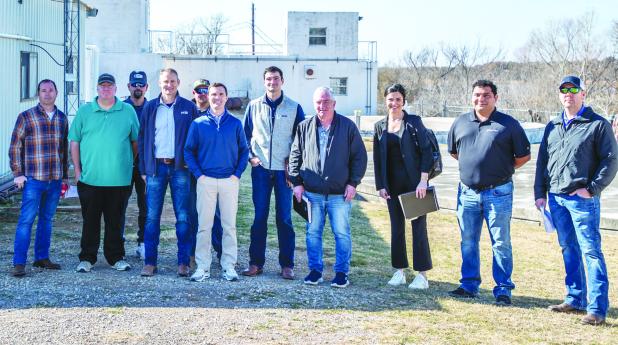
The three companies vying to build Olney’s next water treatment plant stood last Thursday morning in the shadow of the city’s existing one — a collection of buildings and concrete tanks that has done its job for generations.
Representatives from Purifics, DuPont Water Systems, and Aria Filtra gathered Feb. 12 at the Lake Olney treatment plant to walk the site beside Lake Olney with city officials, plant operators and engineers from Jacob | Martin, the City of Olney’s consulting firm. The purpose: figure out how to launch a monthlong pilot study that will determine which technology will provide Olney’s future water supply.
Within weeks, each company will deliver a self-contained pilot module — essentially a filtration system housed in something resembling a trucking container — and connect it to the city’s raw water line. For 112 days, the three systems will run side-by-side, treating the same Lake Olney water under identical conditions.
“They’ll all be doing it at the same time,” Jacob | Martin project manager Kirt Harle said during the walkthrough. “That’s probably the most important thing we’re going to figure out today — where they’re going to set their units.”
Placement will depend on access to raw water, drainage and electrical power. The group paced the fenced perimeter of the plant, discussing whether the modules would sit inside the existing compound or just outside the gate. Available power is still an open question; vendors may need to bring generators.
The pilot study is designed to test membrane filtration systems that would replace the city’s aging conventional treatment process.
The first eight weeks of testing will focus on two treatment schemes: running raw lake water directly through the membranes, and running raw water with a coagulant added before filtration. Additional phases will evaluate how the systems perform under varying conditions. The city will conduct weekly lab testing, and vendors will collect and report performance data.
During the 112-day pilot period, plant operators will receive training to monitor and troubleshoot the units. While company technicians will remain on call, the city’s staff will manage daily operations.
Once testing concludes, Jacob | Martin will compile a pilot study report for submission to the Texas Commission on Environmental Quality. State review and approval will take several months.
Harle told city officials he anticipates construction of the new plant could be completed by mid-2028.
The existing plant will remain online throughout construction. Mr. Harle described a staged approach that would allow the new facility to be built and brought online while the old one continues operating. At some point, both plants may run simultaneously before the century-old facility is retired.
Residents “won’t even see a disturbance,” he said.