
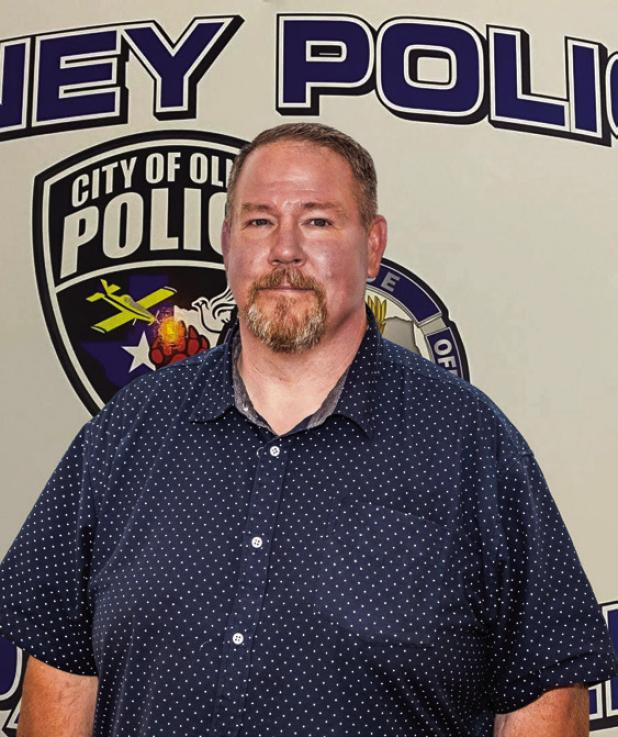
Chief Barrett Gets Up to Speed at OPD
Two months into the job, Olney’s new police chief, Brian Barrett, says he is still listening — to officers, city staff and residents — as he settles into a department he describes as quieter than he expected and a community that has been unusually welcoming.
“It’s a great town with great people,” Chief Barrett said in an interview. “You never know what you’re walking into, but everyone’s been very open about what they think works and what doesn’t.”
Chief Barrett, who was sworn in on Nov. 24, said his early focus has been on understanding how the department operates day to day, from patrol patterns to equipment needs, while resisting the urge to make rapid changes.
One of his first tasks has been reviewing the department’s vehicle replacement strategy — including whether patrol vehicles should be owned or leased — a process he said is still underway.
“I want to know what we have, how we’re using it and where the mileage is,” he said. “Before we move forward, we need a clear picture.”
Chief Barrett said call volume so far has been relatively light, with most incidents involving disturbances rather than serious crime. He said he expected to see more narcotics-related calls than have materialized during his first weeks.
That does not mean, he said, that problems do not exist — only that policing in a small community requires a careful balance between enforcement and restraint.
“There’s a fine line between being overaggressive and being too lax,” he said. “I don’t want officers pulling over somebody’s grandmother for no reason. We need to focus on where the real issues are.”
His philosophy, he said, centers on compliance rather than citations or arrests whenever possible — an approach that does not always show up in statistics or headlines.
“If we can get compliance without enforcement, we’ve done our job,” he said. “That’s hard to measure, but people feel it.”
The department is currently down one officer, Chief Barrett said, and he is actively reviewing applications. He encouraged experienced and well-rounded candidates to apply.
He said officer retention and support are priorities, even as the department works within budget constraints.
“You have a pie,” he said. “How you divide it — equipment, training, personnel — matters.”
The possibility of reinstating a police K9 program remains uncertain. Chief Barrett said he would support such a program only if it were properly funded and staffed.
“A K9 isn’t just a dog — it’s a full-time commitment,” he said. “If we do it, it needs to be done right.”
Chief Barrett said he has already met with key partners in the criminal justice system, including the district attorney, sheriff and child advocacy groups, and stressed the importance of coordination in cases involving vulnerable populations.
Protecting children and the elderly, he said, is nonnegotiable.
“When those folks can’t help themselves, we’re all in,” he said.
Asked about federal immigration enforcement activity reported by residents outside city limits, Chief Barrett said the department is not coordinating with federal agencies and has had no direct involvement.
“They don’t have to notify us,” he said. “Just like any other federal entity, they can come and go.”
For now, Chief Barrett said his priority is learning the community, supporting his officers and maintaining steady, professional policing.
“I try to be accessible and available,” he said. “If something’s not working, we adjust. That’s how you move forward.”