
City explains new water rate surcharge
The Olney City Council will be looking at strategies in coming weeks to cover a projected $60,000 gap between projected revenues from the recently approved water projects surcharge and its 2023 debt service payments for the new water treatment plant.
A study commissioned by the city and performed by NewGen Strategies shows that the City’s water rates plus the surcharge are “sufficient” to cover its fiscal year 2022 debt payment on the $13.5 million in revenue bonds sold earlier this month.
“Additional adjustments to water rates will be needed in the future reflective of capital needs and inflationary impacts on expenses,” the report said.
The NextGen report urged City leaders to look at raising rates next year, as part of Olney’s commitment “to charging rates and charges which will produce sufficient revenue to cover its costs and honor its commitments.”
Mayor Rue Rogers instructed a subcommittee of the City Council earlier this month to study the impact of a higher surcharge or higher rates on Olney residents. Rogers said the Council spoke with community and church leaders to get ideas about how to blunt the impact of higher rates for low-income residents before selling the bonds.
He noted that low-income residents of Olney Housing Authority’s 14 housing complexes are mostly shielded from rate increases because the Authority pays their water bills.
OHA pays the water bills for residents in 181 units, said OHA Occupancy Director Helen Guerra. Residents in 40 apartments in the Highland West complex at Richmond Street and West Grey Street, and in 30 units on West Avenue G, West Howard Street, and West Edwards Street pay their own water bills, she said.
“We know this is going to have an impact on the entire community, but the Council must make decisions to ensure the City can provide treated water,” Rogers said. “The needed upgrades have real costs, but it’s something we must do. These are never easy decisions.”
The water project surcharge was adopted in January, and will rise from $10 per meter between February and April, to $20 per meter between May and July, and top out at $30 per meter starting in August. The surcharge was designed to fund improvements to the City’s 100-year-old water treatment plant and aging infrastructure, and will be in place indefinitely as the City pays off the 30-year notes on the plant.
The water project surcharge was adopted in January, and will rise from $10 per meter between February and April, to $20 per meter between May and July, and top out at $30 per meter starting in August. The surcharge was designed to fund improvements to the city’s 100-year-old water treatment plant and aging infrastructure, and will be in place indefinitely as the City pays off the 30-year notes on the plant.
Construction on the new facility is expected to begin this summer.
The City will use annual projected revenues from the surcharges of $259,965 to pay $240,327 in debt service in fiscal year 2022, the report said.
Because of the higher interest rates associated with a three-month delay in selling the revenue bonds, the city faces a shortfall starting in fiscal year 2023 when the surcharge will deliver estimated revenues of $623,916 against debt service payments of $686,000.
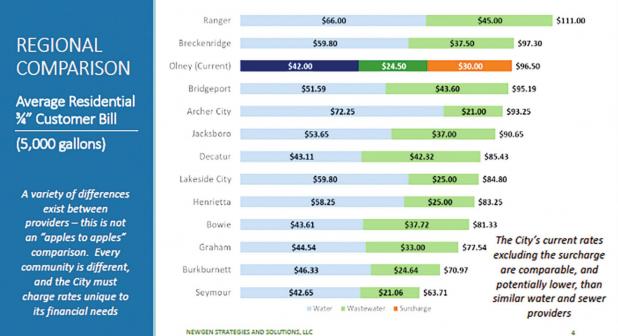
The report showed that the city’s current water rates excluding the surcharge are markedly lower than water rates in surrounding towns. Average residential water bills for an Olney customer who uses 5,000 gallons per month were $42, compared to $53.65 per month for a customer in Jacksboro, $44.54 for a Graham customer and $72.25 for a customer in Archer City
At $64.50, Olney’s average monthly combined water and wastewater bills are cheaper than most surrounding cities, and the $30 per month surcharge puts local rates behind the $111.00 per month average costs in Ranger and the $97.30 per month that citizens of Breckenridge pay for water and wastewater, the report shows.
Due to the surcharge, the city does not require a rate increase in 2022 to produce net revenues of 1.1 times anticipated debt service requirements, the report said. But the city council should review rates against during the budget process for fiscal year 2023 to correct the anticipated shortfall of $62,884, the report said.
As a condition of the loan, the City must set rates that will collect enough money to pay its expenses, pay all of its debt service obligations and have a 10 percent margin. The surcharge was originally designed with a $2 per meter surplus over debt service payments for a 2.4 percent general obligation bond scheduled for sale in January. Those funds were earmarked for improvements to the water delivery system but that margin was wiped out by the higher interest rates of 3.56 percent revenue bonds the City ended up selling in early April.
The City anticipates collecting about $1.7 million from water and wastewater bills in each of the next two fiscal years, and $101.799 in other revenue.